
2026 World Rowing Beach Sprint Finals begin with challenging coastal conditions
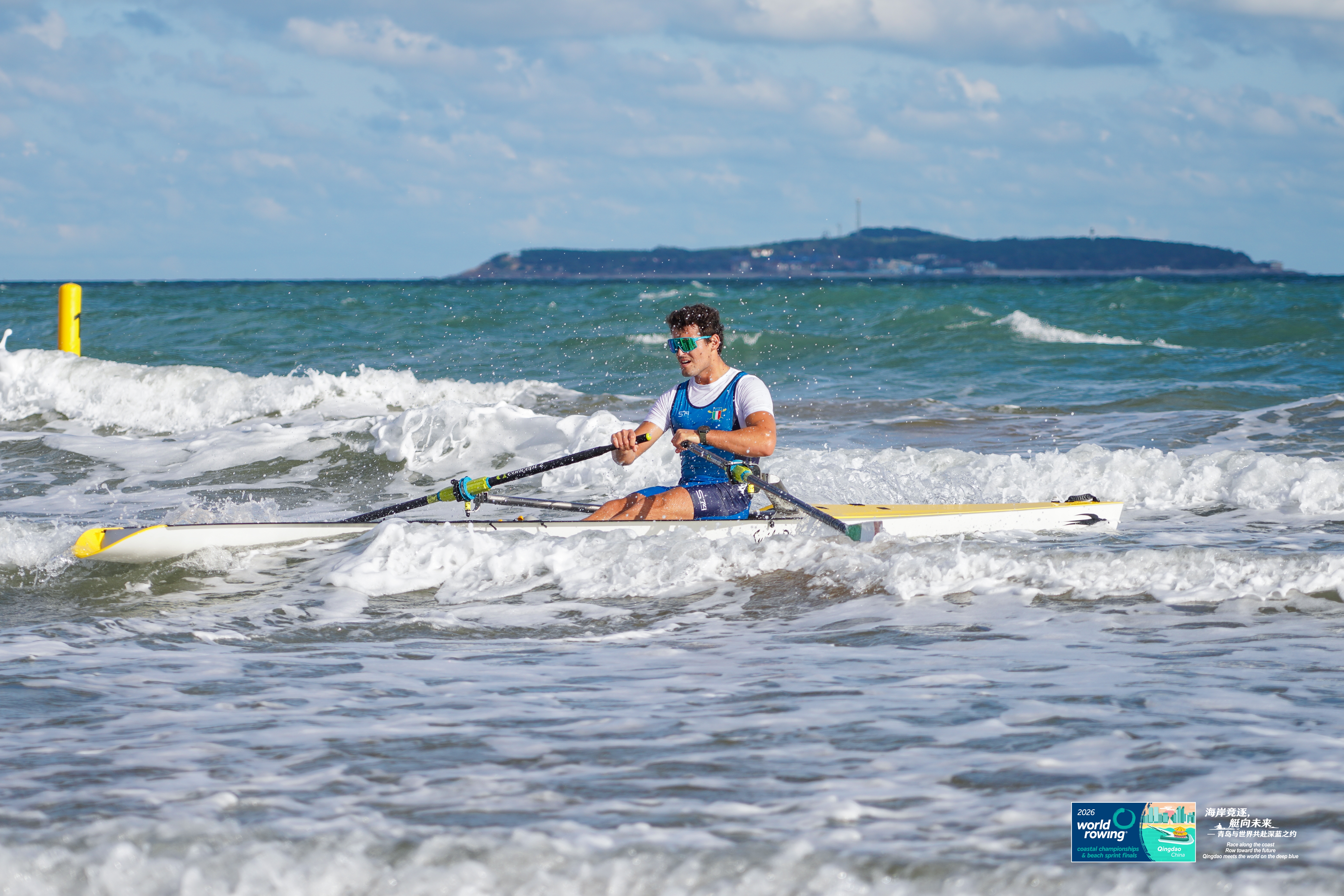
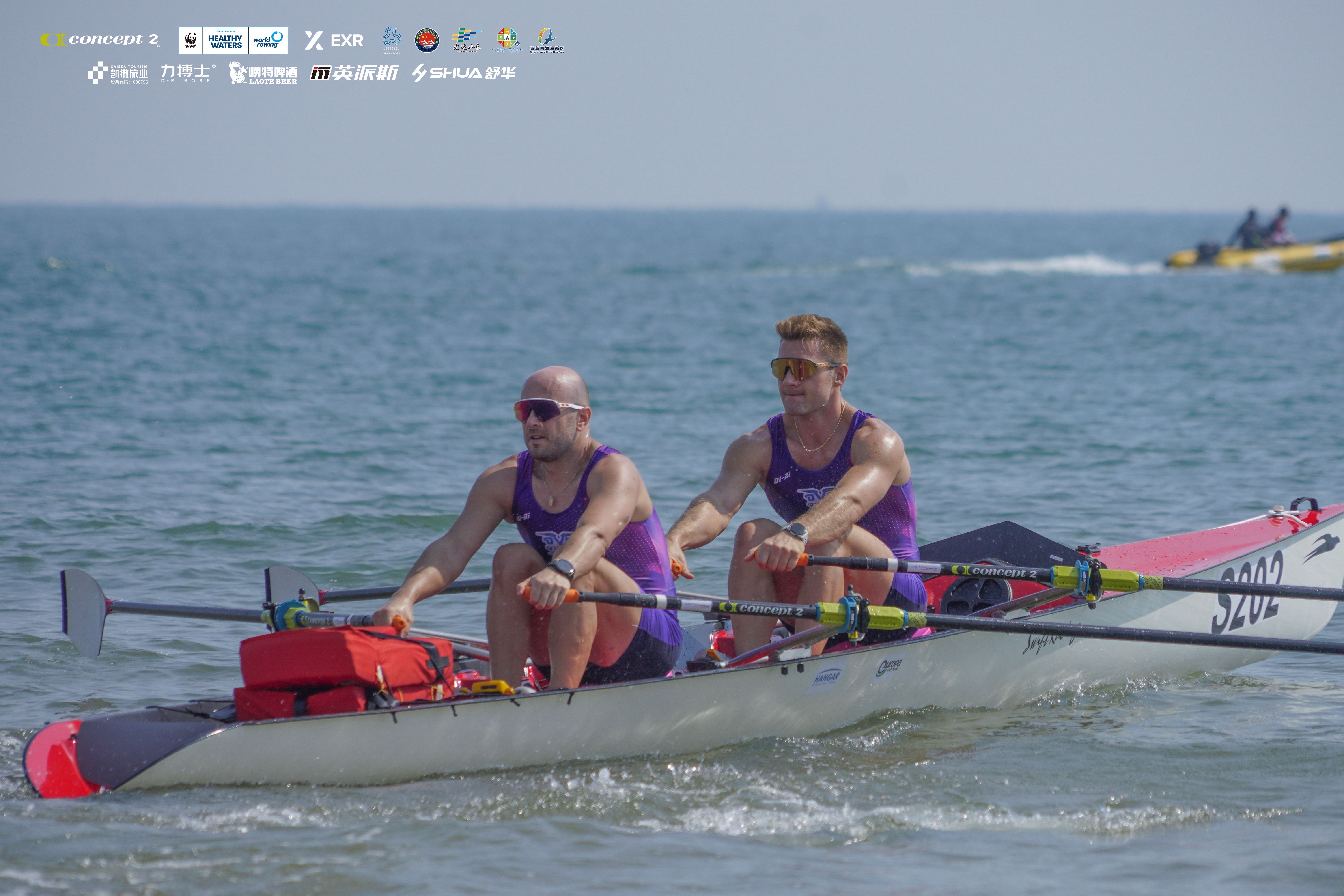
The 2026 World Rowing Beach Sprint Finals got underway in Qingdao, China on Monday with a morning testing athletes’ coastal skills on the Yellow Sea.
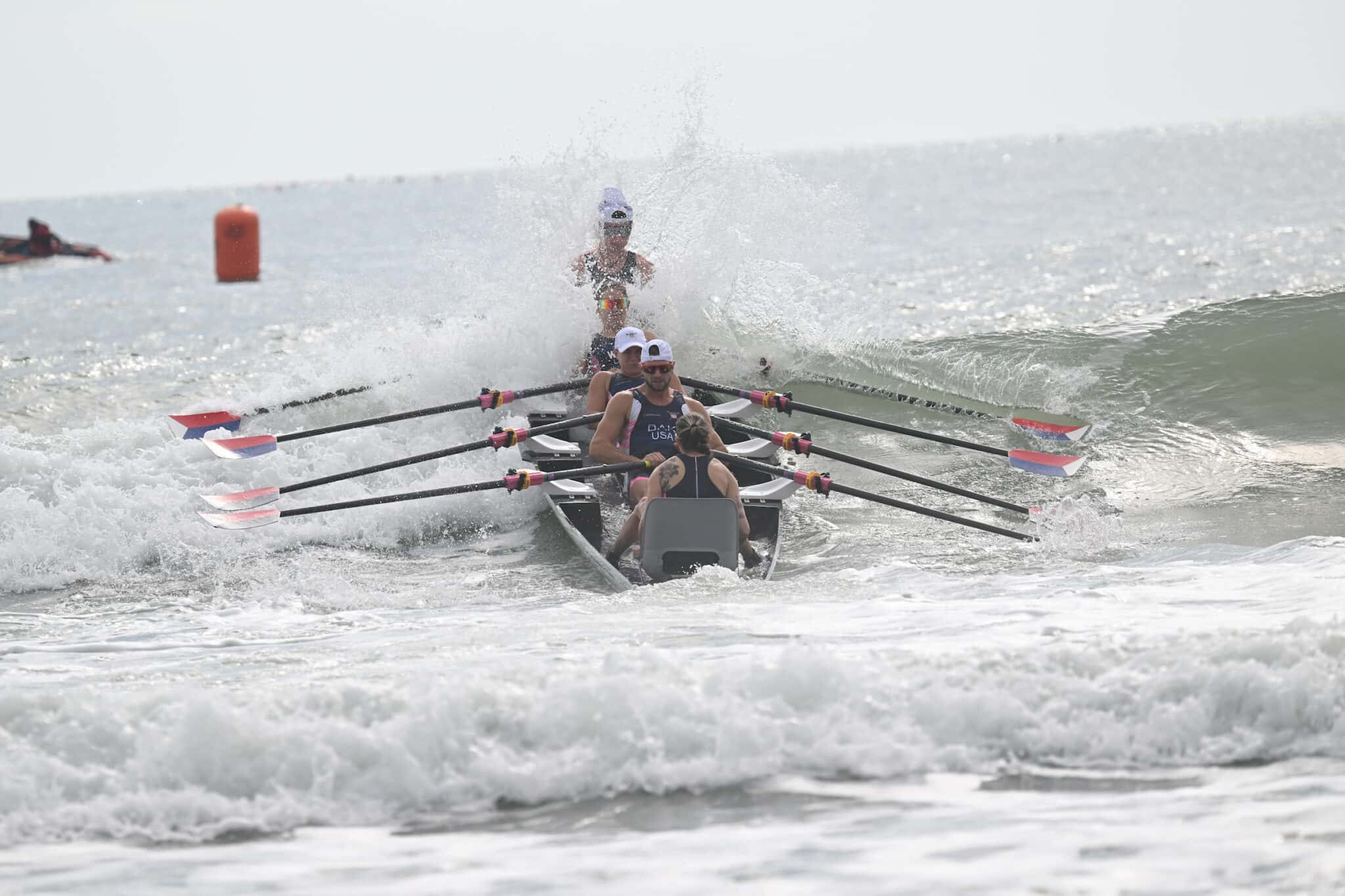
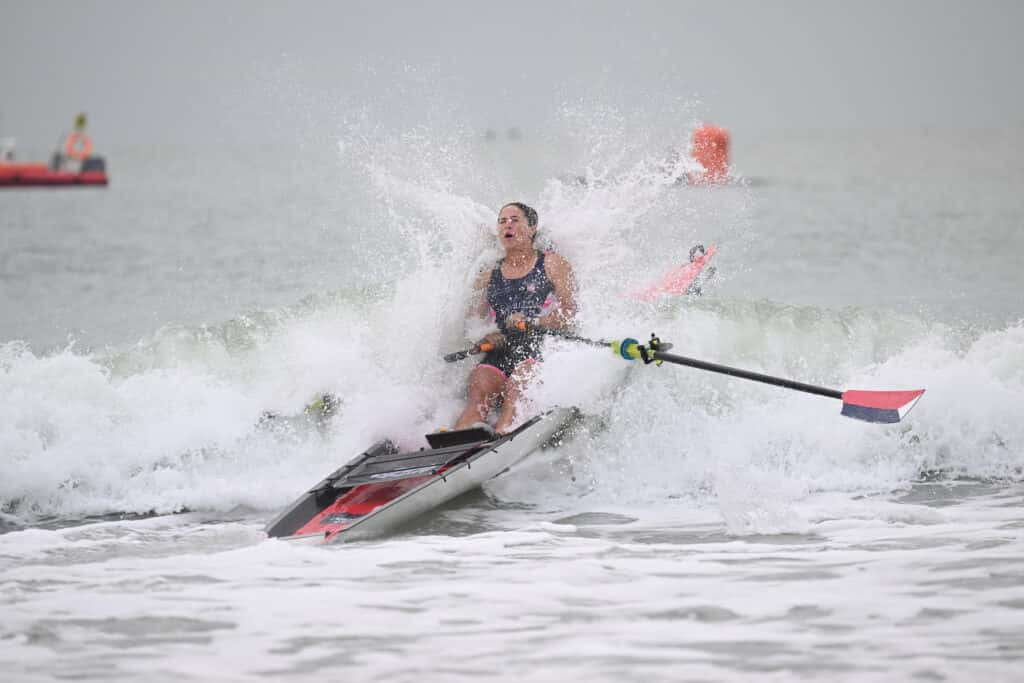
Irregular breaking waves made it challenging for rowers to get a clean start off the beach and to land again, and there were a number of capsizes. But the conditions also provided plenty of excitement for the spectators in the stands – including family and friends from around the world as well as local Chinese schoolchildren experiencing the thrills of beach sprints for the first time.
The day predominantly consisted of time trials, whittling down the large number of entrants to the final 16 or eight crews – depending on the event – who will contest the knockout rounds on Tuesday and Wednesday. No defending champion came out on top of the standings, showing the unpredictability of the discipline.
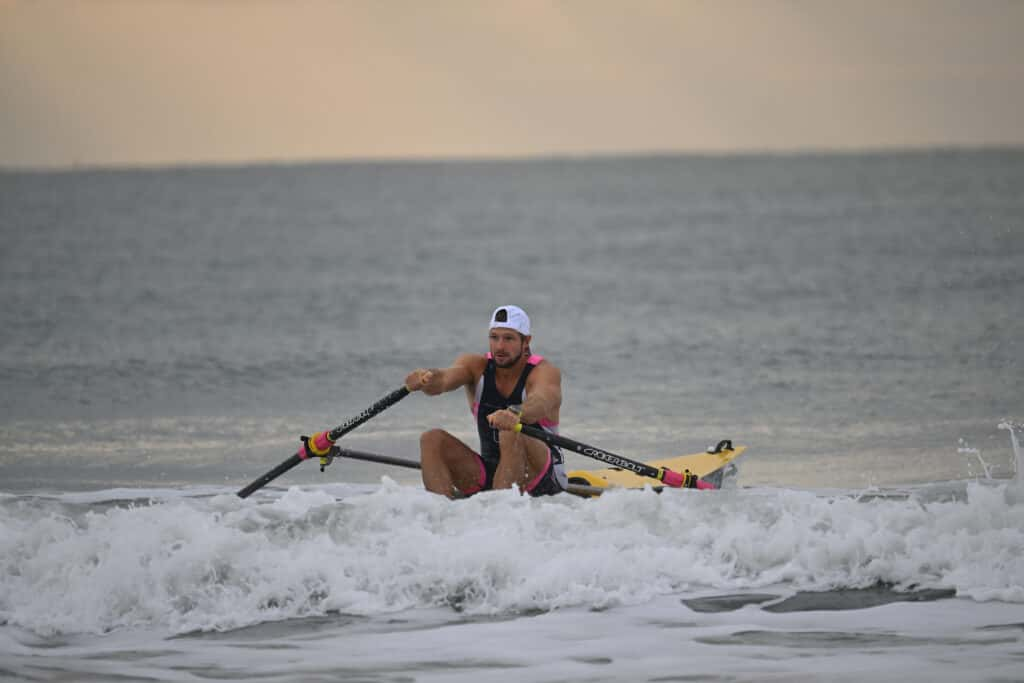
In the Men’s Solo, Germany’s Moritz Wolff was the quickest of the 45 entrants, beating reigning and record world champion Christopher Bak (USA) by 3.3 seconds.
On the women’s side, beach sprints debutante Isabella Scammell (AUS) was comfortably the quickest athlete. Scammell backed up that performance with the time trial win in the coastal mixed double sculls alongside Oscar Scheel Gamborg, pushing defending champions Lithuania into second place.
European champions Ander Martin and Esther Briz (both ESP) had to go through the second time trial to ensure their place in the knockout round of the solos, but both progressed safely.
The day saw the beach sprints debut for eight nations, with plenty of noteworthy performances. Indonesia impressed by beating Egypt in the repechage of the mixed coxed quadruple sculls to qualify for the last eight, and their women’s solo, Parisa Chaempudsa, also reached the last 16.
Colombia’s Alejandro Riccardi qualified for the knockout round of the under 19 men’s solos, losing narrowly to Raphael de Boussac (FRA) in his nation’s first appearance at a World Beach Sprint Finals.
China’s Bu Boren (men) and Zhu Weiwei (women) won the time trials of the under 19 men’s and women’s solos, with both progressing through to the last eight. And Germany, Italy and Great Britain emerged as the time trial winners of the under 19 mixed, men’s and women’s double sculls – but with times close among the top crews, the knockout rounds are likely to be exciting in these events.
Racing continues in Qingdao on Tuesday 20 October from 07:00 local time (23:00 UTC, Monday 19 October). Medals will be won in the under 19 men’s and women’s double sculls, the inclusion mixed double sculls, the men’s and women’s solos and the under 19 men’s and women’s solos.
Inside the chaos and choreography of a beach sprint
On the face of it, a beach sprint race is just that – a race. The person who reaches the finish first will win.
However, there are a huge number of variables contained within the three minutes or so that a race will take that can mean the winner is not necessarily the fastest athlete.
“In beach sprints I don’t think there’s a specific key. There are so many elements where you can gain or lose time,” says Great Britain’s Cameron Buchan, noting consistency in the main beach sprint skills is vital.
The Start
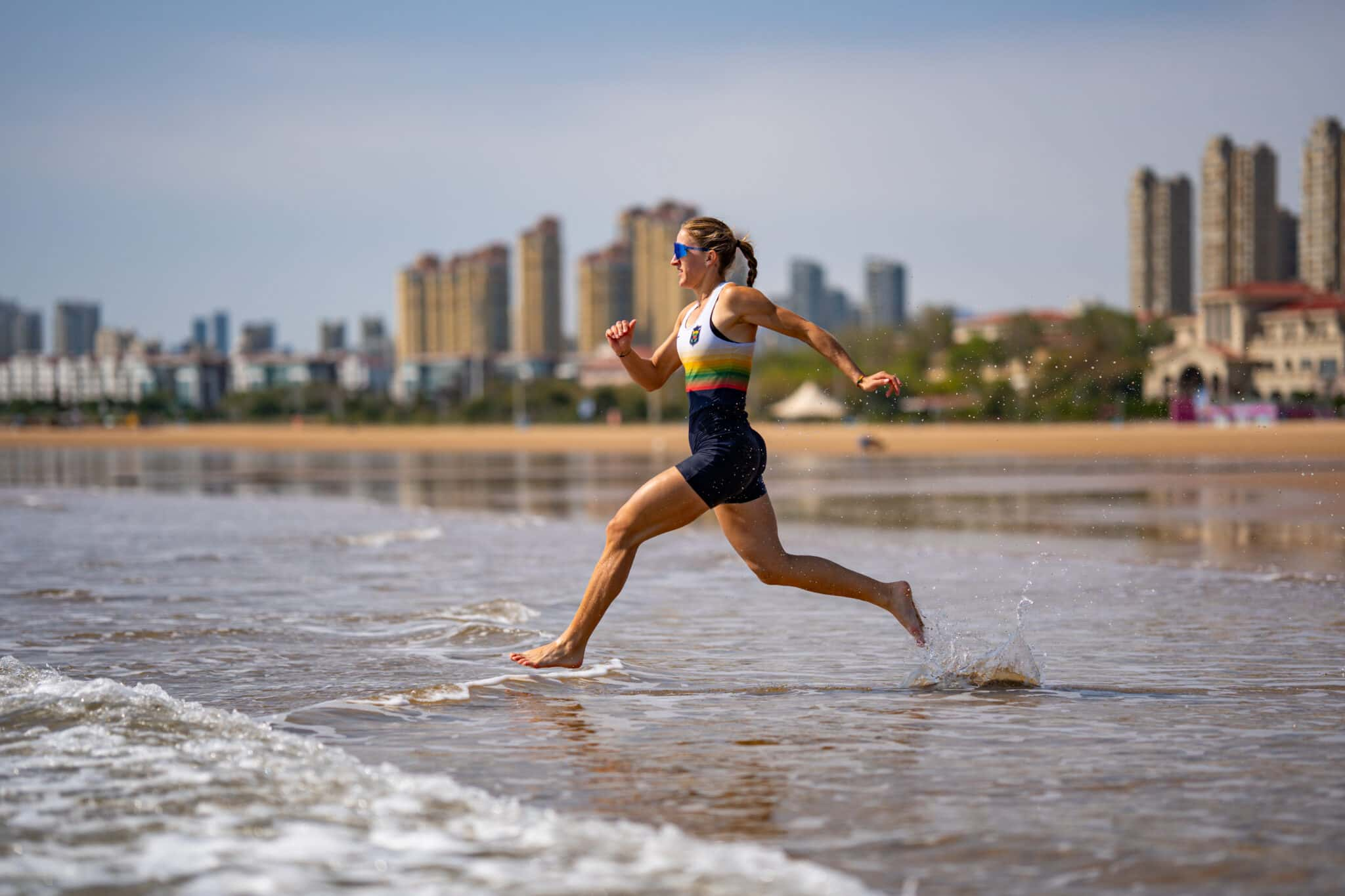
Training days, especially before the World Rowing Beach Sprint Finals, means dialling in the details (Balint Csucz / World Rowing)
Beach sprints races start on land, with a run. Especially on beaches with big tidal ranges, as in Saundersfoot at the 2022 World Rowing Beach Sprint Finals, or in Qingdao in 2026, the run becomes longer, as the finish timing system cannot easily be moved as the tide goes out.
“The way I think about it is you’re not going to win the race on a run but you could lose it on the run,” says USA rower Christine Cavallo. She says it is important to train the body to be able to sprint while also not unduly taxing the energy system that needs to then start rowing.
“In bumpy conditions, it’s about being relaxed, being almost slow so that you can be clean. You lose so much more time with a bad entry or a bad exit than you would if you have a slightly slower one if you make it clean,” agrees Buchan.
The Entry
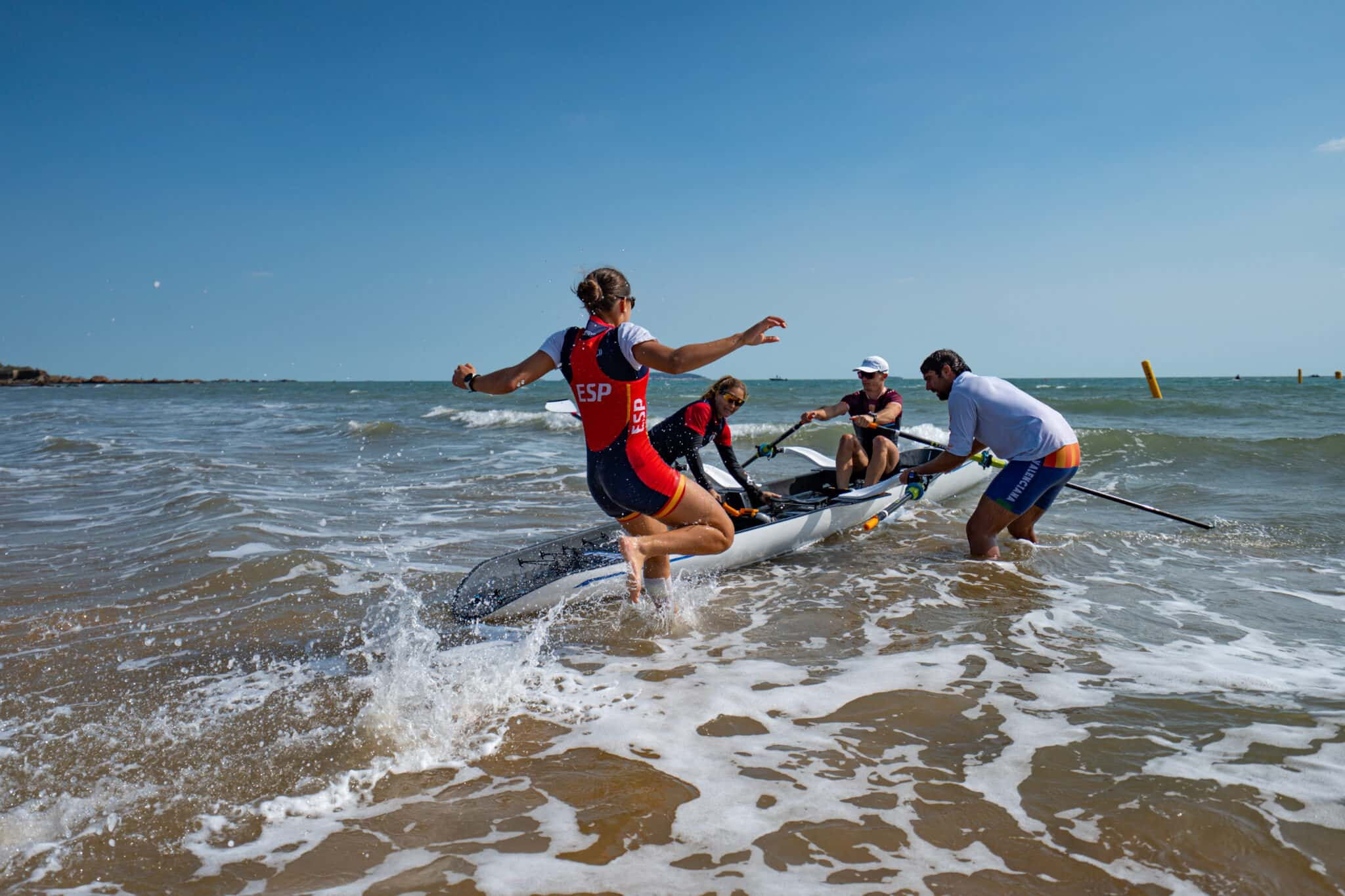
More training time getting the details right before the 2026 World Rowing Beach Sprint Finals get underway on Monday in QIngdao, China (Balint Czucz/World Rowing)
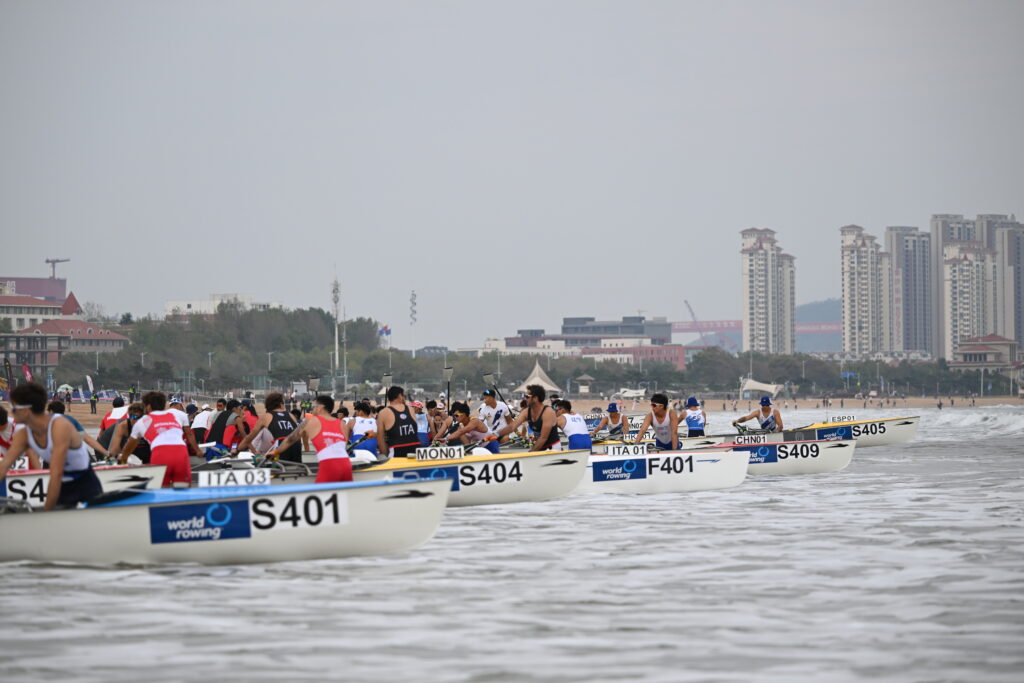
Unique to coastal rowing are the boat handlers – usually two per boat, except in rougher conditions when the jury can allow extra handlers. Athletes will pitch in to help handle boats when they are not racing themselves, and bigger teams have specialist boat handlers who really know how to keep a boat in position on the surf to give their rower or rowers the best possible start.
One athlete in every discipline sprints to the boat and jumps in it; in doubles and quads, the remaining rowers jump in while their crewmates are running. For the runner, the entry is important as you need to jump in, grab the oar handles and get your feet in place all while the handlers are pushing the boat off.
Beach Sprints and Coastal racing see athletes often managing their rowing shells through the ocean break (Detlev Seyb/World Rowing)
“I would compare it to jumping on a horse bareback; you just kind of have to do it,” says Canada’s Carling Zeeman. “You can practise all you like but it’s going to be different every time. You have to be a little bit physically aware of yourself: know where your hands are, know where your feet are, trust your boat handlers and pray.”
The boat handlers will then give their boat a shove and also begin steering their crew out towards the first of the three buoys on the course.
The Race
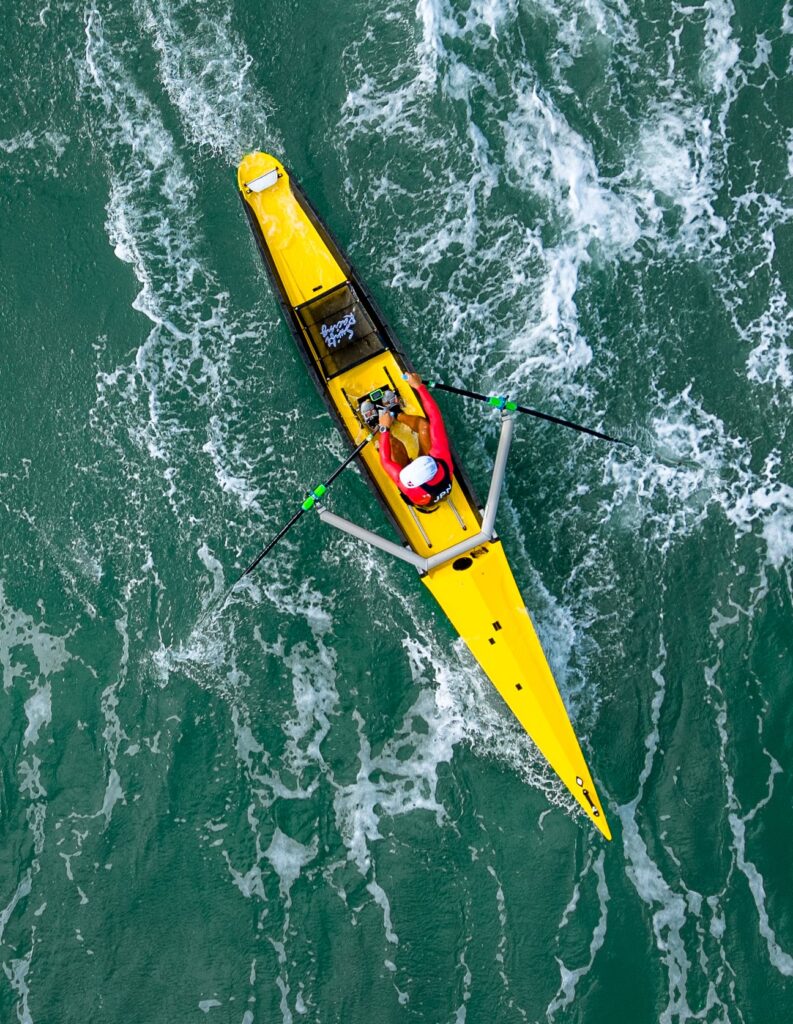
Beach sprints involve a 250m slalom row with two buoys to navigate before a 180-degree turn around a final buoy, followed by a straight sprint back to the beach. It sounds simple, but navigating the course while managing conditions isn’t.
“We’re so used to rowing being very structured in our lanes, but here – this beach, especially – anything goes. You can use such a wide range of tactics and strategies to get round,” points out New Zealander Matt Dunham.
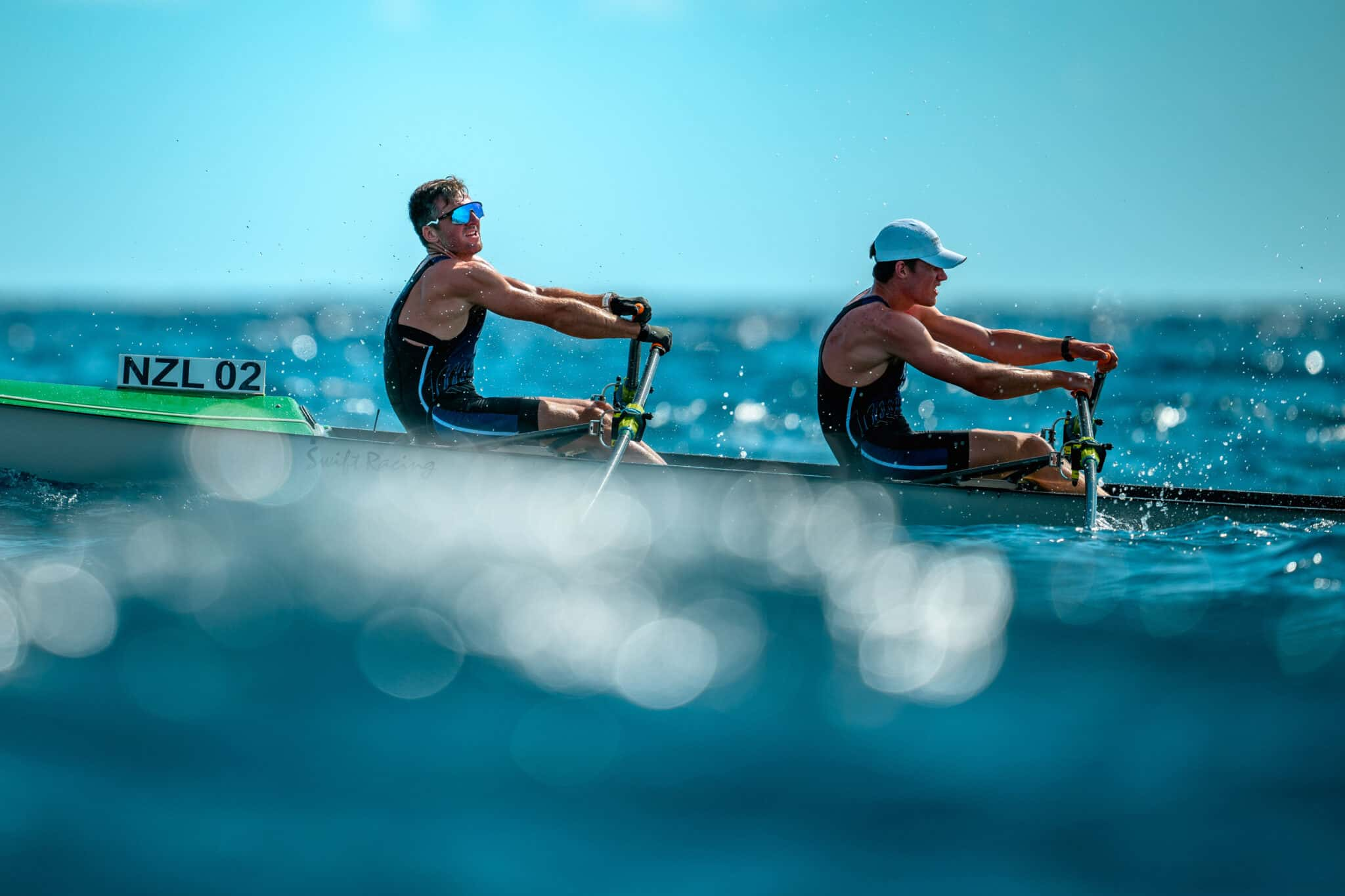
Matthew Dunham (b) and Finlay Hamill (s) racing the Coastal Men’s Double Sculls for New Zealand at the 2024 World Rowing Coastal Championships in Genoa, Italy © World Rowing / Benedict Tufnell
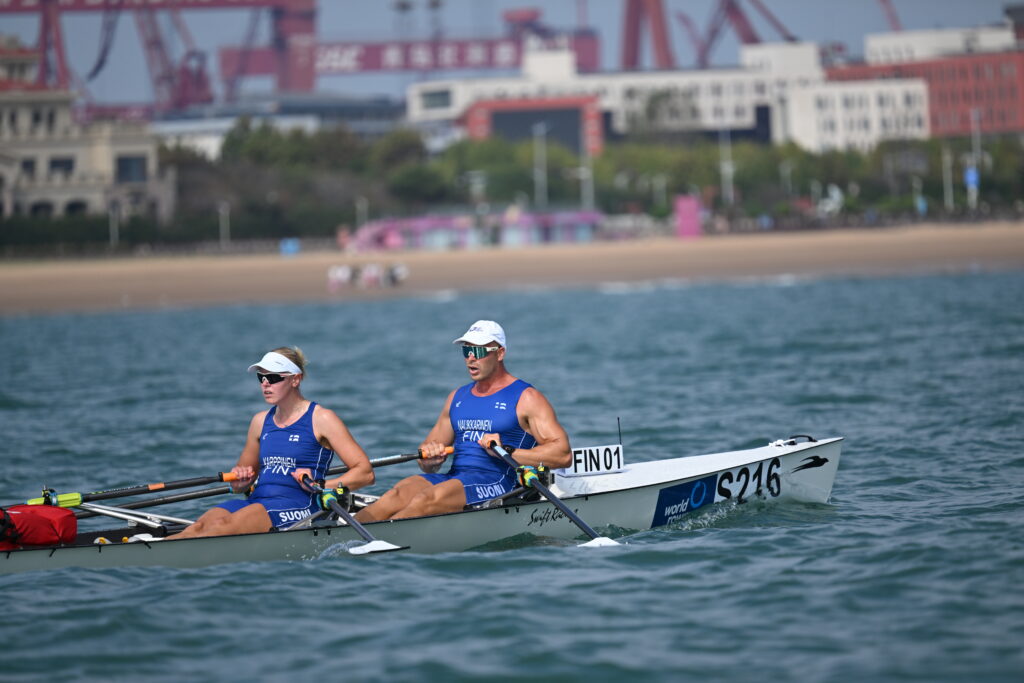
“For a flat-water rower, I think one of the biggest changes is accepting that the perfect rowing stroke is no longer always the fastest solution. On flat water we spend years trying to make every stroke repeatable. In coastal rowing, sometimes the wave decides what stroke you are going to take,” adds Joel Naukkarinen of Finland.
Zeeman agrees. “You can pull as hard as you want, but if you’re not on the wave right, it’s game over. It’s such an athletic condition out there.
“Sometimes you have one hand on the oar, sometimes your hand is on the shaft, sometimes your foot is out. If you don’t catch the wave right the ocean’s so powerful it will just push you right over,” she says.
Those conditions mean physiological strength becomes key. Beach sprint boats are shared between athletes, so the only adjustables are the foot stretcher placement and the height of the gates.
“Because the boat is so heavy at the catch you need to make the most of it as the boat is accelerating. Your back and arms and lats and overall connection to the footplate need to be incredibly strong,” says Cavallo. “These skills have helped me going back to flat water because now I understand what it means to be deeply connected through to the back end.”
The Exit and Finishing Sprint
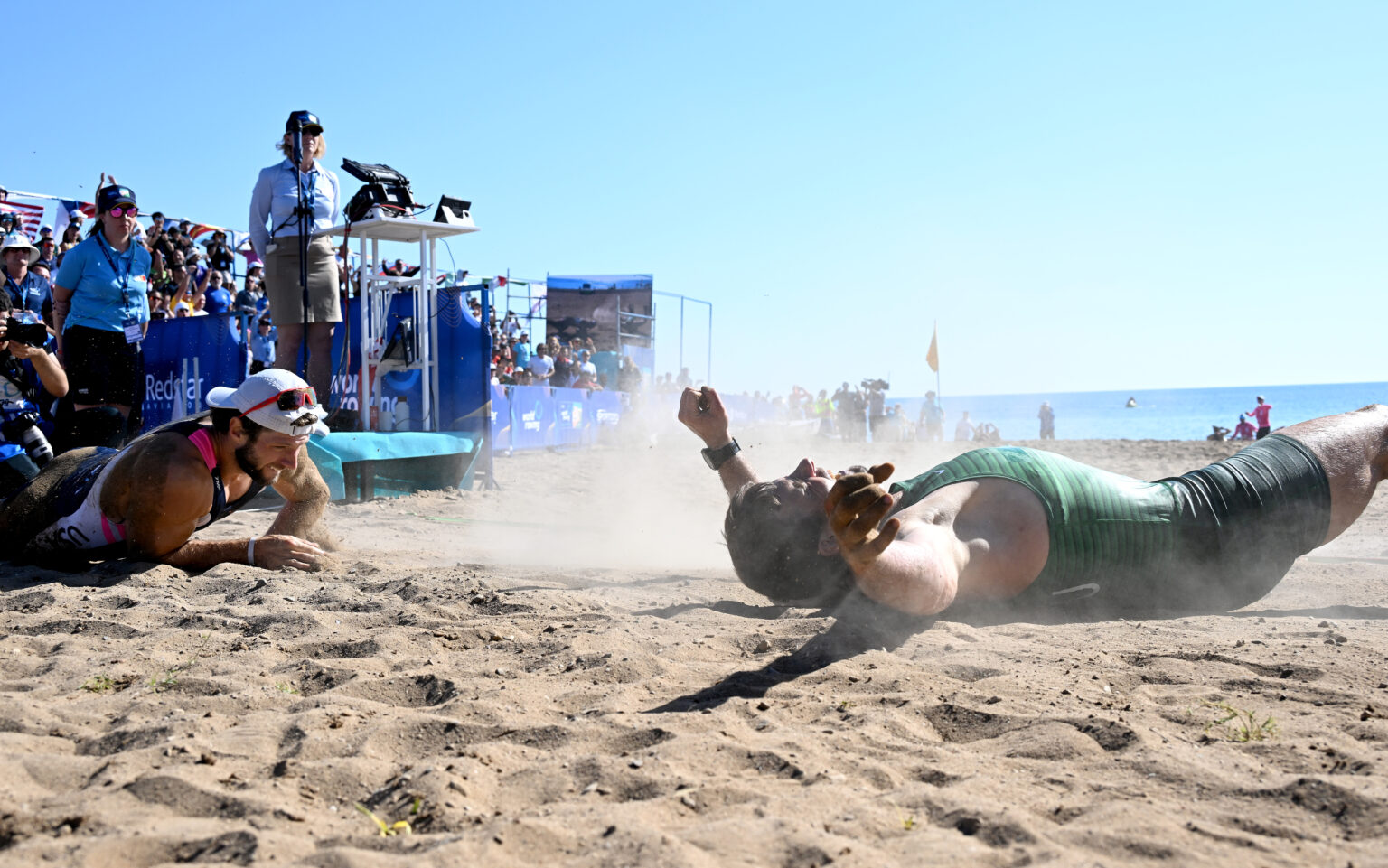
The finish couldn’t have been closer in the Mixed Doubles at the 2025 World Rowing Beach Sprint Finals in Antalya, Türkiye © Detlev Seyb / MyRowingPhoto.com
On landing at the beach, rowers rely on their boat handlers to safely call them in – perhaps missing a stroke while surfing a wave – before leaping out of the boat and sprinting around a set of flags to hit a buzzer on the sand. If they are exhausted, it can be hard to sprint, and races have been lost as a result. Slipping on the boat exit is also not uncommon in a tight race where every tenth of a second can count.
The Vibe
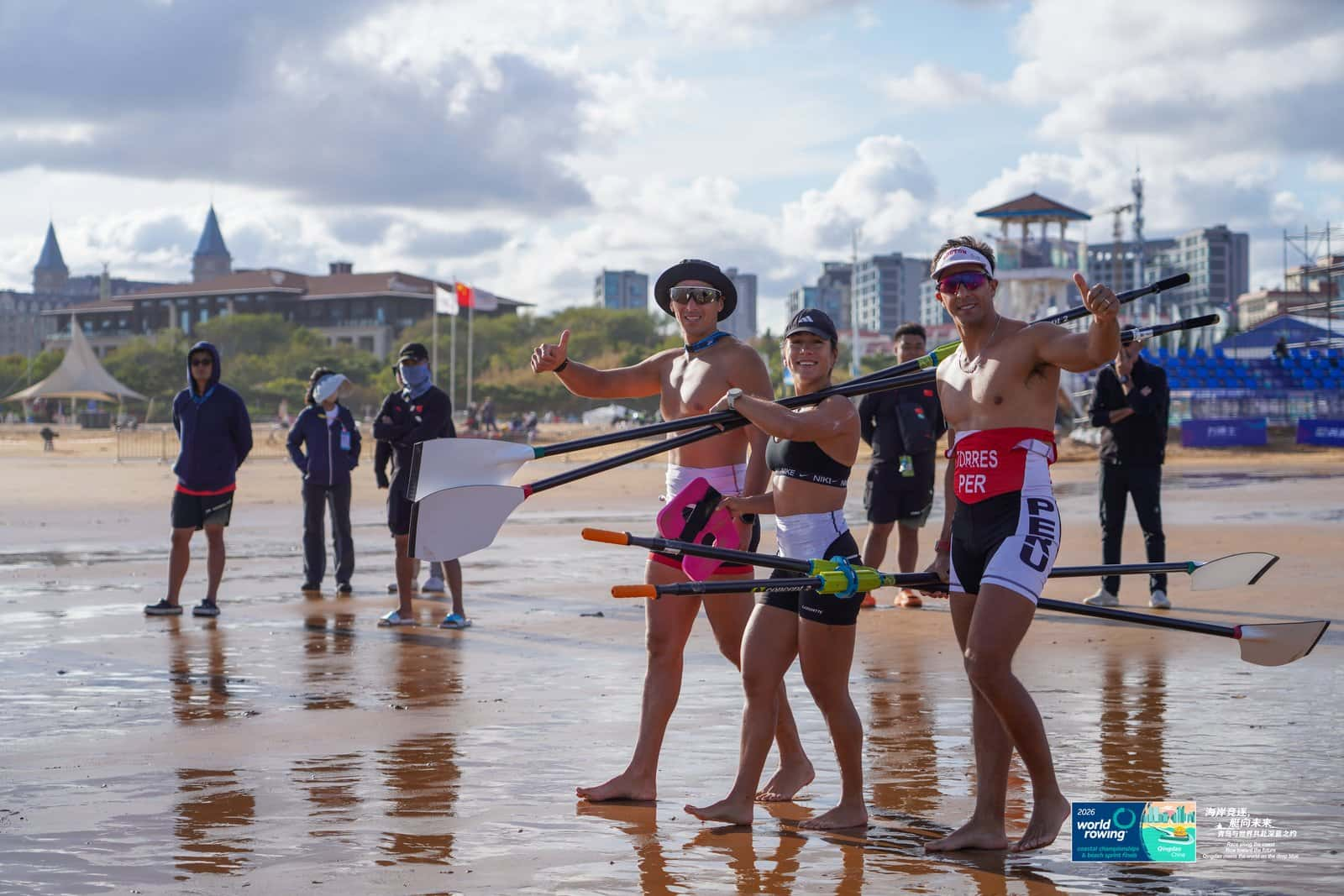
The vibe in Qingdao in the lead-up to the 2026 World Rowing Beach Sprint Finals
Driving every beach sprint rower on is the unique beach atmosphere. It is a head-to-head race, and spectators are close by, with music pumping during the race.
“Due to the dynamic nature, the head-to-head racing makes it really exciting, not only from a competitors’ standpoint but also from a spectator standpoint, I think it’s really something special,” says multiple world champion Chris Bak of the USA.
Podium-time for the Coastal Mixed Coxed Quadruple Sculls at the 2025 World Rowing Beach Sprint Finals in Antalya, Türkiye © Detlev Seyb / MyRowingPhoto.com
“That’s something which you don’t get in flat water rowing, that you always have contact to your teammates and to the other competitors – also for the spectators, because you’re so close to them. When you pass them at the grandstands they can almost touch you,” agrees Austria’s Magdalena Lobnig.
The People
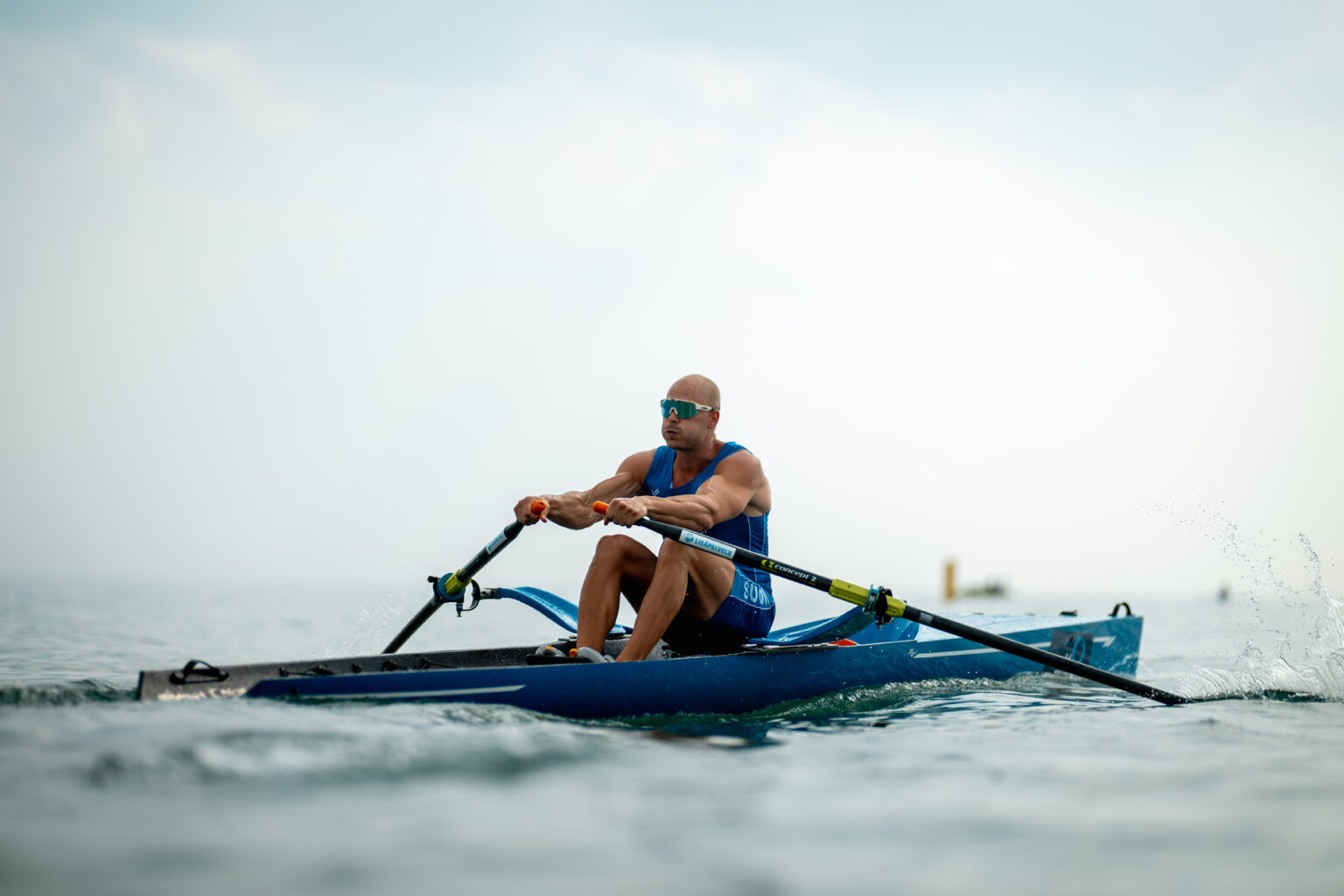
Joel Naukkarinen of Finland racing the Coastal Men’s Solo at the 2025 World Rowing Beach Sprint Finals in Antalya, Türkiye © World Rowing / Benedict Tufnell
While traditionally, flat water rowing has attracted tall, strong athletes with long levers, there is a much wider range of physicality on show at a beach sprint event – from short, compact athletes to long and lanky.
“There are obvious advantages to being bigger and more powerful once the boat is moving, but beach sprint asks for much more than that. You also have to run, accelerate your own body and the boat repeatedly, change direction quickly, deal with all the vertical movement created by the waves, move efficiently around the boat, handle transitions and react to changing conditions,” says Naukkarinen.
“A lighter and more agile athlete may gain time in the running and transitions, while a bigger athlete may have an advantage in power production and boat speed. The relative importance of those qualities can also change depending on the course and conditions.”
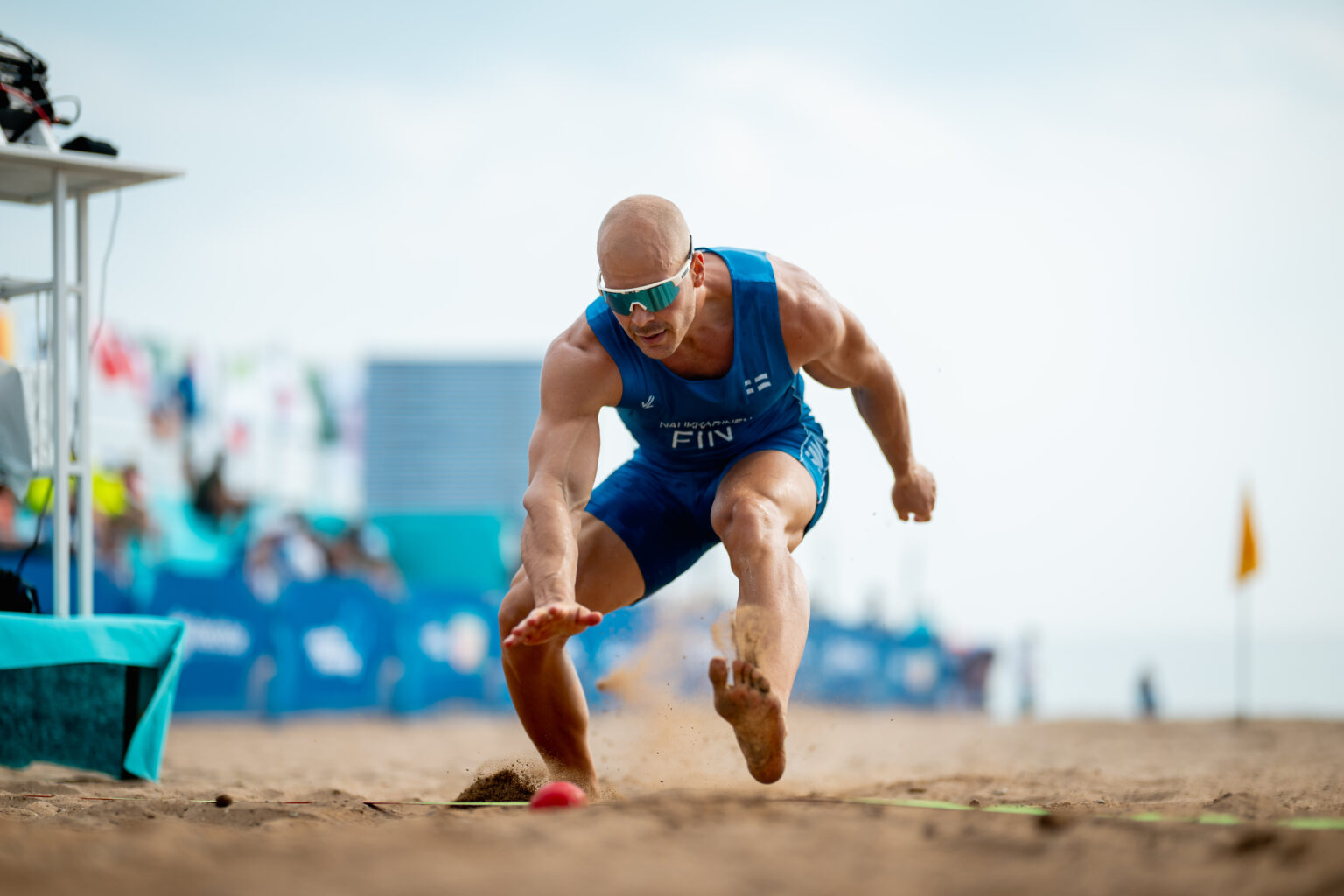
Joel Naukkarinen’s sprint to the finish buzzer at the 2025 World Rowing Beach Sprint Finals in Antalya, Türkiye © World Rowing / Benedict Tufnell
Although in an individual race speed is key, athletes also need endurance, as someone wanting to win a gold medal must complete three races within about half an hour. Those coming from flat water may find this physiological aspect the easiest to grasp. But training needs to account for both the strength and explosiveness required on the start and during the race, while also giving rowers the engines they require to keep going again and again in physically and mentally challenging conditions.
Buchan says the British team split their training through the year into stages, in order to be ready for the big races when it counts.
“The racing’s short, much shorter than a flat water race or an endurance race, but you have to do it multiple times back to back to back. So to build that explosive work you need that base of endurance over time and then build it up to create that peak of explosiveness,” he adds.
Putting it together
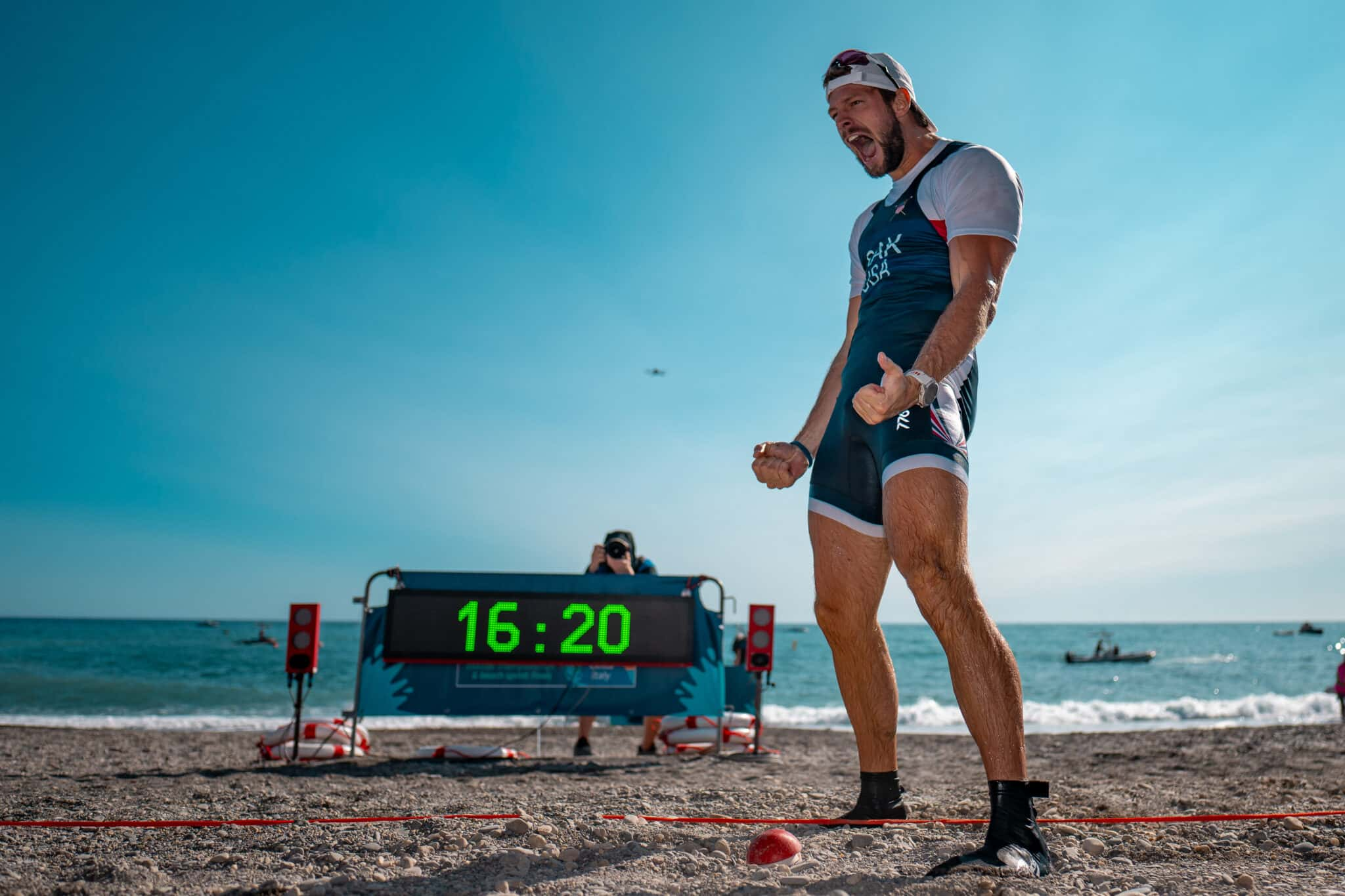
USA’s Christopher Bak celebrates his performance in the Coastal Men’s Solo at the 2024 World Rowing Beach Sprint Finals in Genoa, Italy © World Rowing / Benedict Tufnell
The rowers who can put together a fast run, get off to a good start, survive the Qingdao surf, and reach the buzzer safely will be the ones who thrive in the next days on the Yellow Sea. Conditions are set to be challenging, and the racing will be thrilling from start to finish. It all begins on Sunday 18 October at 07:00 local time (23:00 UTC on Saturday 17 October).
How to Follow the 2026 World Rowing Beach Sprint Finals
The world’s best beach sprint rowers are set to take on the sand and surf of Qingdao, China, as the 2026 World Rowing Beach Sprint Finals take place from 18-21 October at Golden Beach.
With more than 300 athletes representing 52 nations, the event will bring together the largest names in coastal rowing for four days of spectacular racing. Combining explosive speed on the beach, technical boat handling on the water and dramatic head-to-head knockout racing, the Beach Sprint Finals promise excitement from the first race to the last.
What is beach sprint rowing?
Beach sprint rowing is the fast-paced, elimination-format discipline of coastal rowing and will make its Olympic debut at the Los Angeles 2028 Olympic Games.
Athletes begin each race with a sprint across the sand before launching their boats into the surf. They then race out to sea, complete a series of buoy turns, and return to the beach, where they jump from their boats and sprint across the finish line.
The discipline combines rowing power, running speed, technical skill and tactical awareness, creating some of the most dramatic races in the sport.
Why Qingdao?
Golden Beach in Qingdao provides a spectacular setting for the championships. Situated on the coast of the Yellow Sea, the venue offers a unique mix of open-water conditions, challenging surf and a stunning beachfront atmosphere.
Following the World Rowing Coastal Championships earlier in the month, the world’s top beach sprint athletes will return to the same venue to contest world titles in one of rowing’s fastest-growing disciplines.
How to follow
Fans can follow all the action from Qingdao through World Rowing’s digital platforms.
Live blog
The official World Rowing live blog will provide updates, results, key moments and stories from throughout the championships on WorldRowing.com.
Live results and racing programme
The full racing programme, start lists and results will be available on WorldRowing.com throughout the event, allowing fans to follow every race from the opening rounds through to the medal finals.
Live audio
Live audio commentary will be available on all four days of racing, bringing fans closer to the action from Golden Beach.
Live video
Live video coverage will be available on 20 and 21 October, covering the decisive stages of the championships and the races for world titles.
Social media
Follow the action across World Rowing Coastal social channels for highlights, behind-the-scenes content, athlete reactions and the best images from Qingdao:
Instagram: @worldrowing.coastal
Facebook: World Rowing Coastal
Four days to crown the world’s best
Over four days of racing, more than 300 athletes from 52 nations will battle for world titles on the shores of the Yellow Sea. From dramatic finishes on the sand to tactical duels around the buoys, the 2026 World Rowing Beach Sprint Finals promise to showcase the excitement and intensity that have made beach sprint rowing one of the sport’s most rapidly growing disciplines.
Be sure to follow all the action from Qingdao on WorldRowing.com, with the live blog, live audio coverage every day, and live video coverage on 20 and 21 October.
Athletes’ Commission Election Continue in Qingdao: Coastal Rowing Vote Comes During the 2026 Beach Sprint Finals
First, flatwater rowers weighed in on who would represent them at Amsterdam’s Bosbaan during the 2026 World Rowing Championships. Now, coastal rowers and beach sprint athletes will vote in the World Rowing Athletes’ Commission at the 2026 World Rowing Beach Sprint Finals in Qingdao, China’s Yellow Sea.
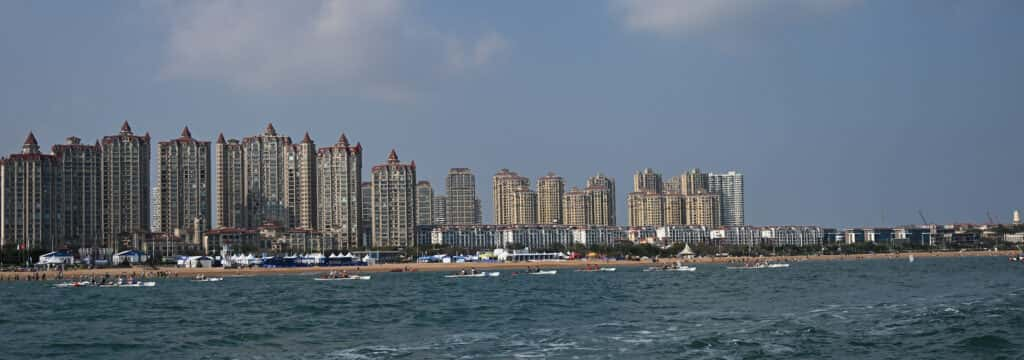
Racing is underway in Qingdao, China, with the 2026 World Rowing Coastal Championships, which will be followed by the 2026 World Rowing Beach Sprint Finals from 18-21 October 2026
As the voice of rowing competitors, commission members make sure athletes’ views are heard at World Rowing. They listen to what matters to their fellow athletes, bring their ideas and concerns to the table, and work with World Rowing to improve the sport for everyone who competes.
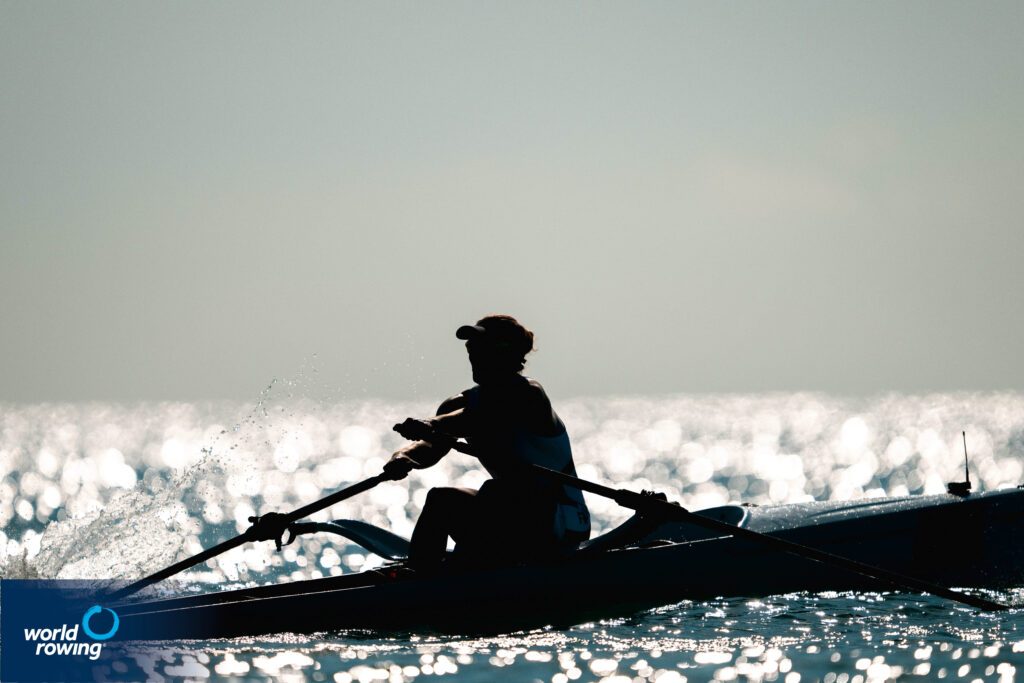
2025 World Rowing Beach Sprint Finals in Antalya, Türkiye © World Rowing / Benedict Tufnell
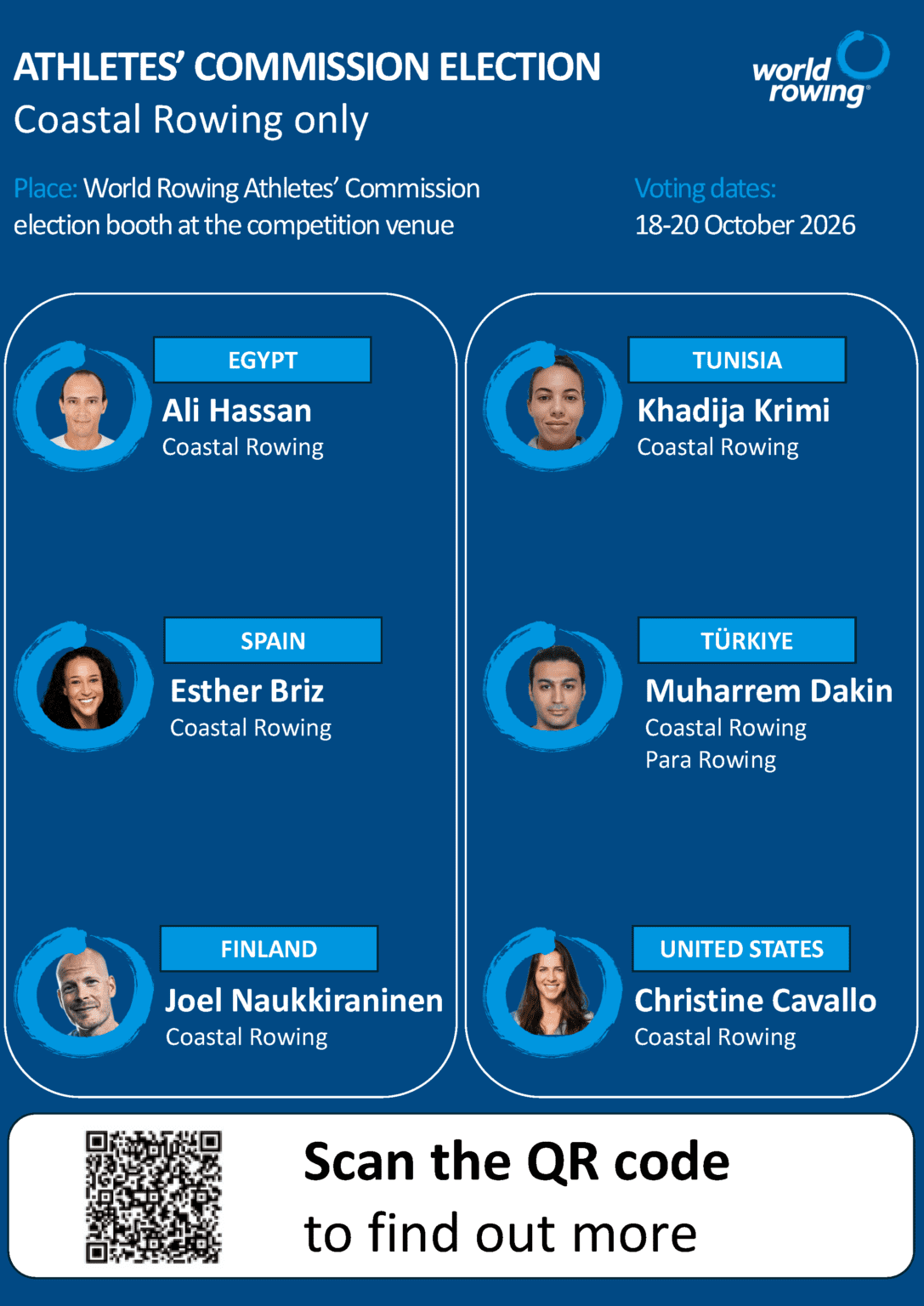
The commission holds elections every four years, halfway through the Olympic cycle. Six candidates are contesting for one coastal rowing seat this time, with the election running from 18-20 October.
The Athletes Commission has 10 members, including at least one para-rower and four classic rowers, and serves as a liaison between active national team rowers and World Rowing. In addition to the five athlete-elected positions on the Commission, the Athletes’ Commission Election and Appointment Committee recommends the other five positions to the World Rowing Council; it is constituted at the start of the relevant election year and oversees the election process.
Lenka Dienstbach-Wechchairs this year’s election committee, and its members includeRonald Chen,Mehdi Garidi,Guin BattenandFrida Svensson. Svensson is the outgoing chair of the Athletes’ Commission and will be on site during the Beach Sprint Finals. Svensson encourages athletes to come say hello, ask questions and share their views on the role of the Athletes’ Commission within World Rowing.
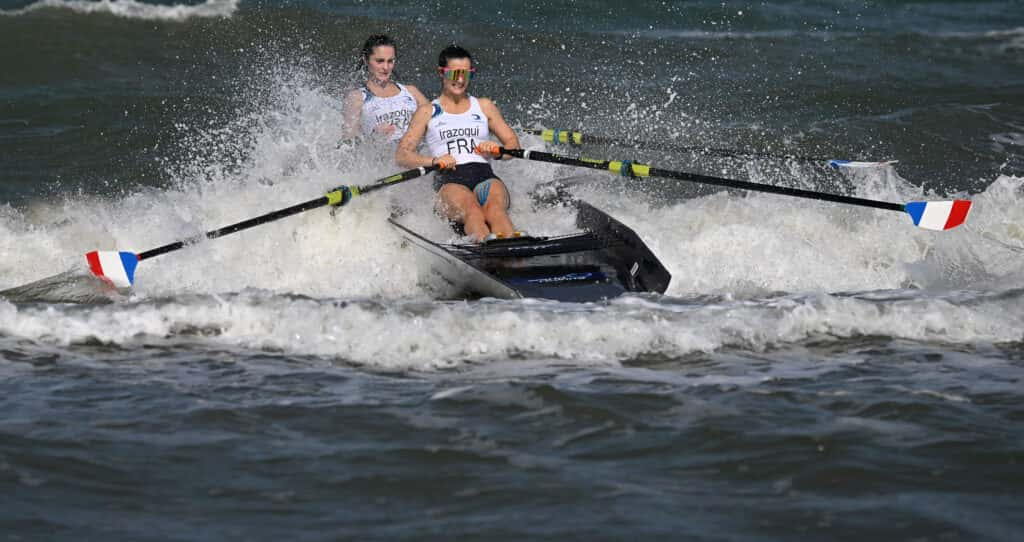
2023 World Rowing Beach Sprint Finals in Barletta, Puglia, Italy © Detlev Seyb / MyRowingPhoto.com
“The Athletes’ Commission is the athletes’ voice within World Rowing, representing them at the highest level of our organisation. The election is an important opportunity for coastal athletes to choose who they want to represent their interests,” said Svensson.
“I encourage every eligible athlete to get to know this year’s candidates, consider what matters most to them, and take part in the vote,” added Svensson.“A strong Athletes’ Commission depends on athletes being engaged and making their voices heard.
“World Rowing puts athletes at the centre of its decision-making. Make sure your voice is part of that process.”
You can find the list of candidateshere.
Finals day in Qingdao delivers close racing from start to finish
The last day of the 2026 World Rowing Coastal Championships produced a string of thrilling races, including a half-length finish after a 6km race in the men’s solo.
The USA took the team trophy and topped the medal table after USA crews won three gold medals and two silvers, ahead of hosts China. China, France, Italy and Finland each won one gold.
Several athletes are going home with two medals. Kory Rogers and Christopher Bak (USA) both picked up a gold and silver, winning the coastal men’s double sculls plus silver in the mixed double sculls and men’s solo respectively. Alexis Fortier (FRA) beat Bak to gold in the men’s solo, after taking bronze with his brother Aymeric in the men’s double sculls.
Joel Naukkarinen and Eeva Karppinen (FIN) won the mixed double sculls, after both took bronze in the solo events, and Bass Andre (GBR) won silver in the women’s solo and women’s coxed quadruple sculls. Twins Alessia and Valeria Palacios (PER) won silver in the women’s double sculls and bronze in the quad.
Boersen wins close women’s solo final
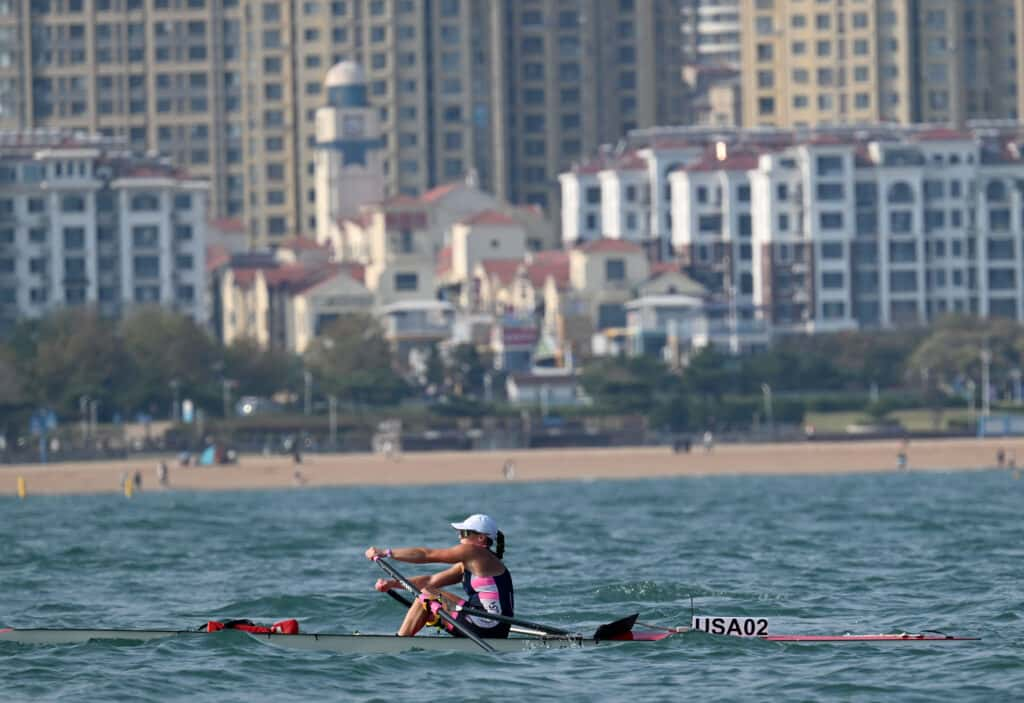
Audrianna Boersen, Coastal Women’s Solo, USRowing Training Center; 2026 World Rowing Coastal
Championships, Qingdao, China; © Detlev Seyb / MyRowingPhoto.com
The first final of the 2026 World Rowing Coastal Championships proved to be a cracking race from start to finish. Christine Cavallo (USA01) and Eeva Karppinen (FIN01) were the early leaders, but with none of the top crews separated by much they found themselves pushed to the wrong side of the first buoy. Both lost a lot of ground as they backed down to take the turn correctly, allowing Audrianna Boersen (USA02) and Gaia Chiavini (MON01) to come out in front. By 2000m Boersen had the advantage as Bass Andre (GBR01) challenged Chiavini, and in the second half of the race Boersen and Andre were comfortably in front. It was neck and neck between the duo until Andre took a turn too wide, opening the door for Boersen to claim gold. Behind them, Karppinen steadily worked her way back through the pack to overhaul Chiavini for bronze.
Results: USA02, GBR01, FIN01
Boersen said:“One of my goals personally was to get out to the first buoy really quick, and it’s always been said that’s a really pivotal point of the race, but I really saw that today. I was in line with everybody and came out of that first turn and that was the first moment I was like‘I could medal’.”
Rogers and Bak reclaim title
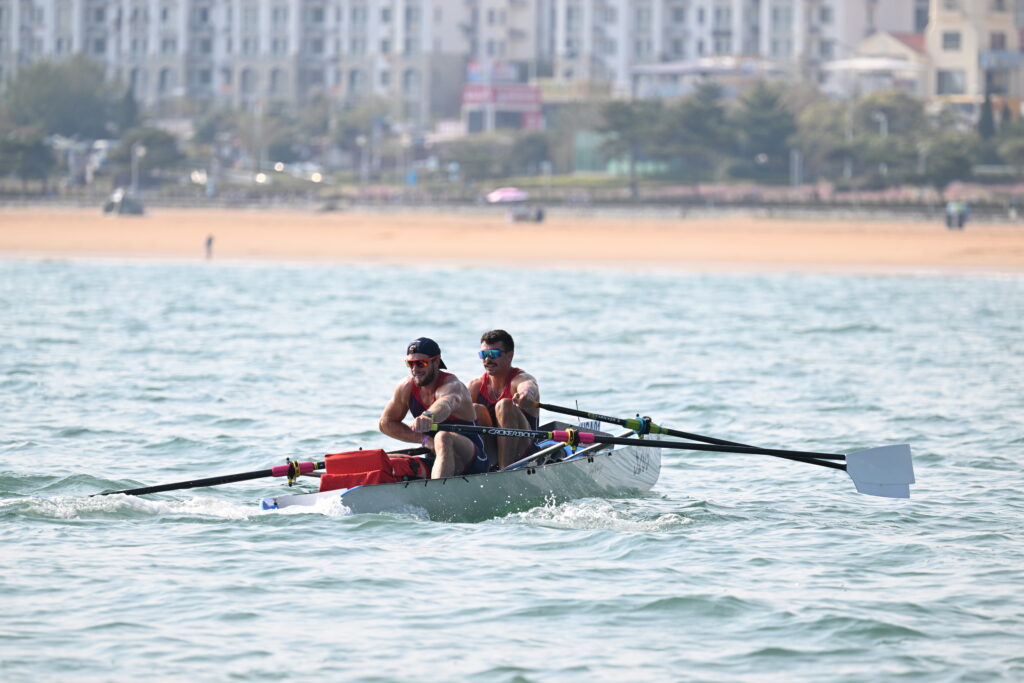
At the last World Rowing Coastal Championships in 2024 in Genoa, Kory Rogers and Chris Bak (USA01) broke an oar and could not defend their 2023 title in the coastal men’s double sculls. In Qingdao the duo made no mistakes, getting out early on and then extending their lead through the race. Behind them, European champions Kealan Mannix and Ronan Byrne (IRL01) had a steady start, tracking Alexis and Aymeric Fortier (FRA02) through the second 1000m and moving into silver medal position by the second timing marker. That was how things stayed for the rest of the race. Behind the leaders, there were some clashes around an early buoy, but the medallists were unaffected.
Results: USA01, IRL01, FRA02
Bak said:“We kept pushing. You never know what can happen on a buoy. You can’t tell on camera, but the wind is really strong today, the surface of the water is pretty flat but you really felt that heavy, heavy wind. So we kept trying to push every stride that we could.”
Three in a row for the USA
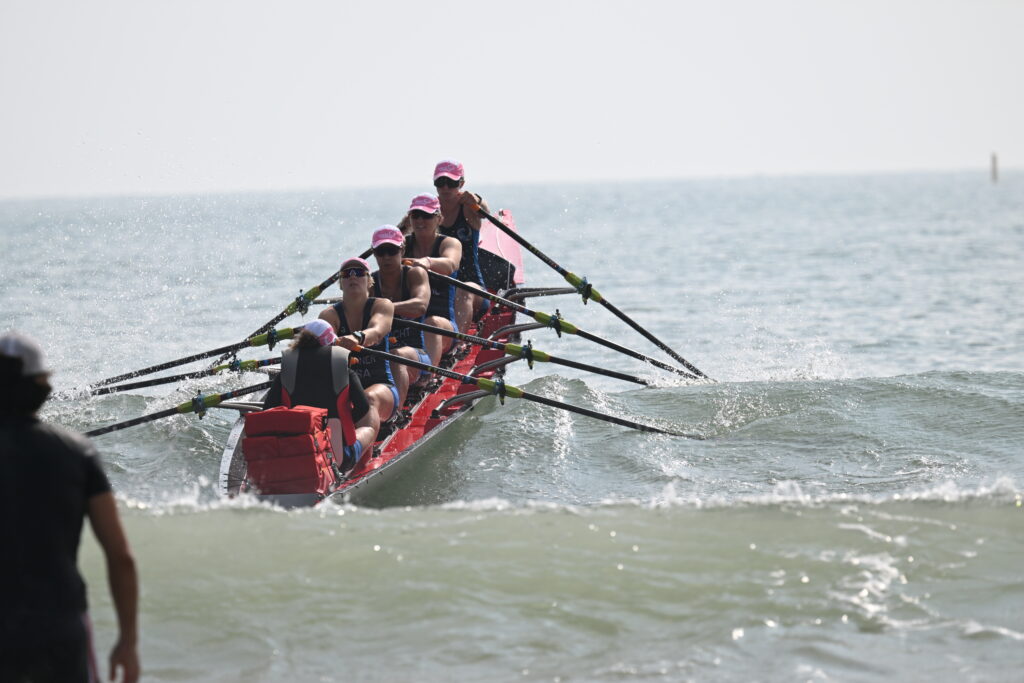
China had a superb start in the coastal women’s coxed quadruple sculls, rounding the 1000m buoy about six seconds up on second-placed Peru. But a crab at 1700m was catastrophic for the Team Liaoning crew, and the rest of the field sailed past them. USA01 came out best and were able to look back on the chasing pack through the middle of the race. Great Britain had a good line around the next couple of turns and were sitting in second, with Peru close to their stern, and USA02 a little further back in fourth. The race for silver brought Great Britain and Peru a little closer to the USA as the race hit 4000m, but the leaders responded. Into the final straight, the USA’s win was confirmed, while the British held off a spirited Peruvian charge for silver.
Results: USA01, GBR01, PER01
Solveig Imsdahl (USA01) said:“We had a good first half, and then around that one buoy our coxswain (Natalie Cleri) took a really good turn, and that’s where we got ahead. And we just held them off for the rest of the race.”
China stay clear of chaos for gold
Zhang Yuanyuan and Sun Luping of Team Liaoning (CHN02) had an excellent race in the women’s double sculls final. They got out early and so kept themselves clear of the multiple clashes around the turning buoys which plagued the other crews. The silver and bronze medals were not decided until late in the race; Cheng Li and Chen Ke (CHN05) were up in silver medal position for the early part of the race, taking tight lines around the buoys, but Alessia and Valeria Palacios (PER01) had caught them by the second timing point and were able to stay clear as Charline Lebreton and Marine Delanoe, Saint-Malo/Carteret (FRA01) motored through the pack into medal contention.
Results: CHN02, PER01, FRA01
Sun said:“The whole race was very good, and I’m very excited. It’s such an honour and I am very excited to win the first race.”
Fortier beats Bak in thriller
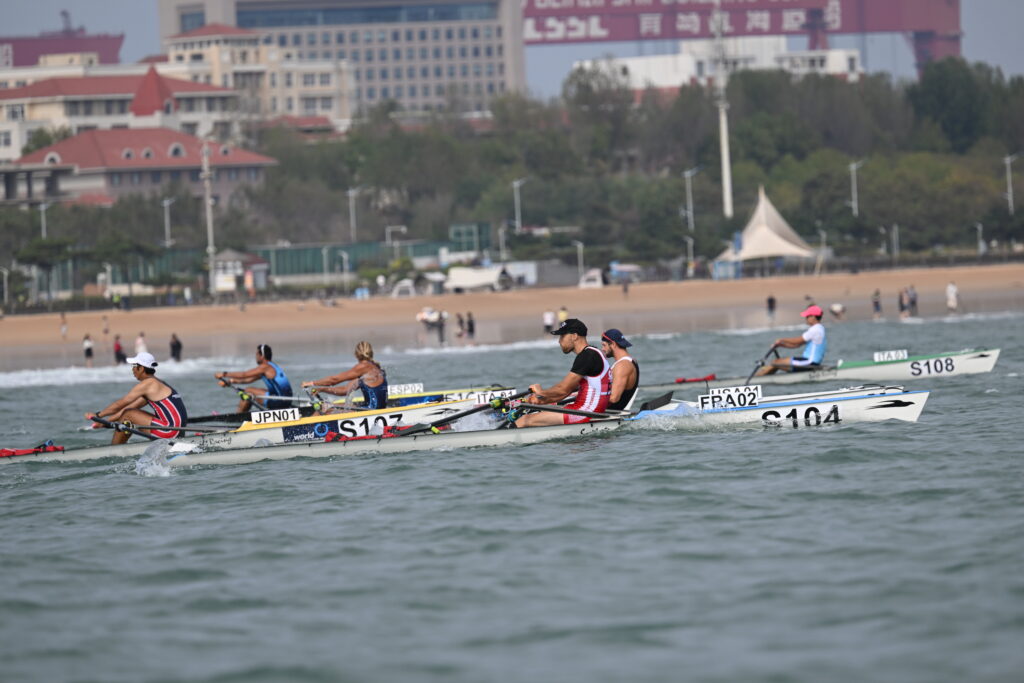
Although the coastal men’s solo medallists were determined by about halfway, the order in which they would finish was far from certain until the line. Joel Naukkarinen (FIN01) had the fastest start, before he was overhauled by Chris Bak (USA01). Alexis Fortier (FRA02) was in a tight pack of boats at the first buoy, but once he got clear he started moving up on the two leaders. Little by little Fortier found more speed, as Naukkarinen, who said afterwards he had had trouble with the pin of his oarlock on the right side, started to slip back. In the third quarter of the race Fortier moved clear of Naukkarinen and up level with Bak, and then just past the USA rower. In the finishing straight Bak put in a huge sprint and closed up to just half a length – but Fortier took gold by 0.79 seconds.
Results: FRA02, USA01, FIN01
Fortier said:“I was involved in a clash at the second buoy and I lost some ground, then I managed to catch up person by person and got past. I never gave up and carried on to the finish. It went well and I’m very happy.”
Gavirate’s quad win gold for Italy
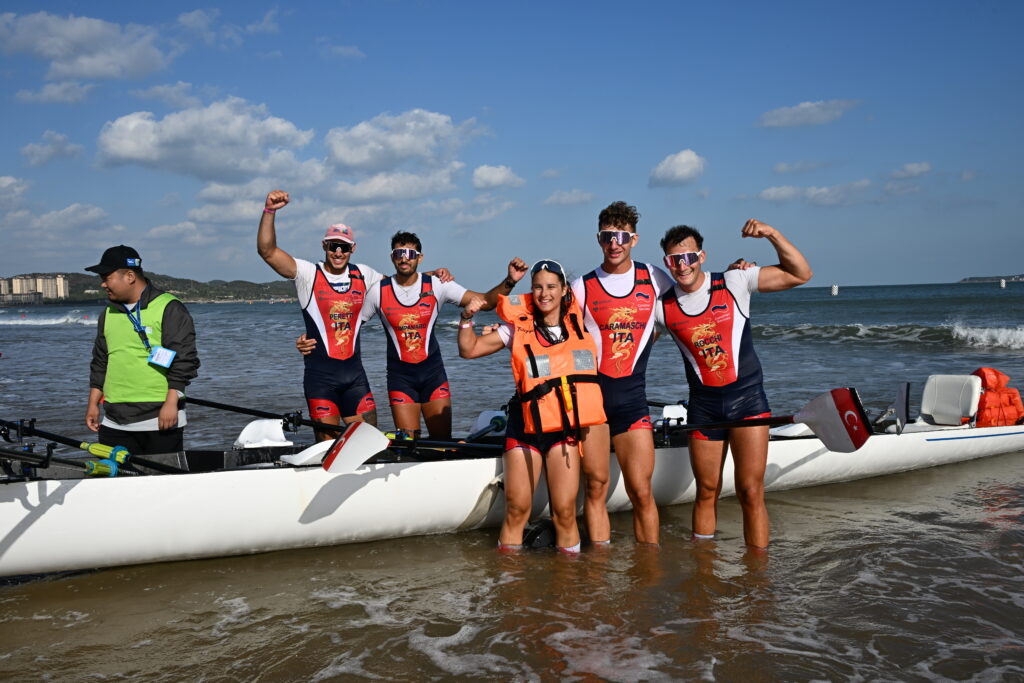
ASD Canottieri Gavirate, rowing as ITA04, had the best start and got to the first buoy ahead in the men’s coxed quadruple sculls final with Team Liaoning (CHN02) close behind. However, as the race developed, it was Monaco and Rowing Club Genovese (ITA03) who moved into silver and bronze medal positions. With Gavirate moving out to a bigger and bigger margin, MON01, ITA03 and CHN02 were in a three-way fight for silver and bronze. Monaco and Genovese had the better finish, with the Monegasque crew hanging on for silver.
Results: ITA04, MON01, ITA03
Rocchi (ITA04) said:“We start very strong, very fast, and we came in the first position and we do all the race in the first position and that was amazing. It was the first race in this crew so we are very happy.”
World gold for European mixed doubles champions
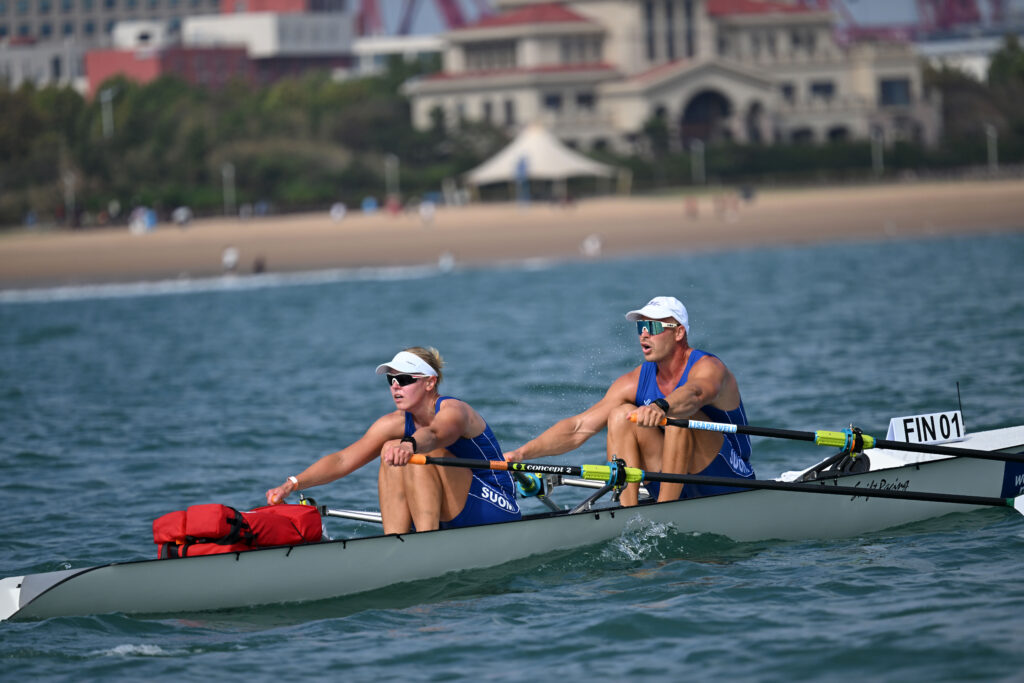
Joel Naukkarinen (b), Eeva Karppinen (s), Coastal Mixed Double Sculls, COMPOSITE – Takon Soutajat/NRC; 2026 World Rowing Coastal Championships, Qingdao, China; © Detlev Seyb / MyRowingPhoto.com
Joel Naukkarinen and Eeva Karppinen (FIN01) added gold to their earlier bronzes in the men’s and women’s solos with a confident performance in the mixed double sculls. Although they were only fourth to 1000m, they had taken the lead by the second timing marker at 2400m and were then able to cruise ahead to victory. Behind them, Kory Rogers and Sera Busse (USA01) had a better start, but slipped back in the middle and got themselves involved in a tight race for silver with Long Zhentao and Yang Yujiao (CHN01). A better turn around the final buoy gave silver to the USA. France had to settle for fourth and fifth.
Results: FIN01, USA01, CHN01
Karppinen said:“It was a really good race, and we rowed relaxed and executed our race plan, so we are super happy with the result.”
2026 World Rowing Coastal Championships off to flying start
The 2026 World Rowing Coastal Championships got underway in Qingdao, China, on Sunday with the heats of three events. While crews were eliminated in the coastal women’s solos, the heats of the women’s coxed quadruple sculls and men’s double sculls gave an indication of who might triumph in Tuesday’s finals.
Cavallo and Chiavini in pole position in women’s solos
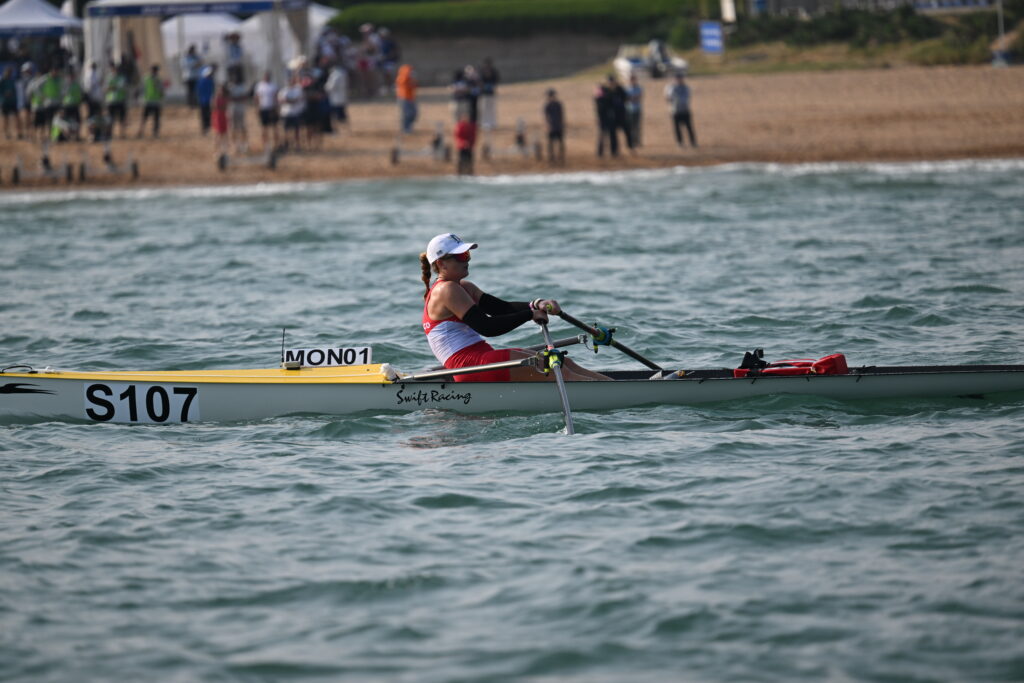
Ahead of racing Christine Cavallo of the USA told World Rowing that a fast start was key to coastal endurance racing – and she put that into practice in heat 1 of the coastal women’s solo, taking a lead of almost six seconds over Tiia-Maria Rauttola (FIN02) by the first turning buoy at 1000m. From there, Cavallo could pick her course and look back on the field. Ilaria Bavazzano (ITA01) moved into second by halfway. At the back of the field, Tiia Ronkainen (FIN04) and Alana Noble (USA05) were off the pace early on and could never close the gap to a qualifying spot.
In heat 2, later on, Eeva Karppinen (FIN01), was first to 1000m but Gaia Chiavini (MON01) had a superb second 1000m to move through the 2024 bronze medallist. The two boats remained locked together for the rest of the race, with the higher-rating Chiavini taking the win less than five seconds ahead of Karppinen. Ma Bingbing (CHN02) was third. Anni Keisanen (FIN03) missed out on the final after fading in the second half of the race.
Peru claim win in women’s quads
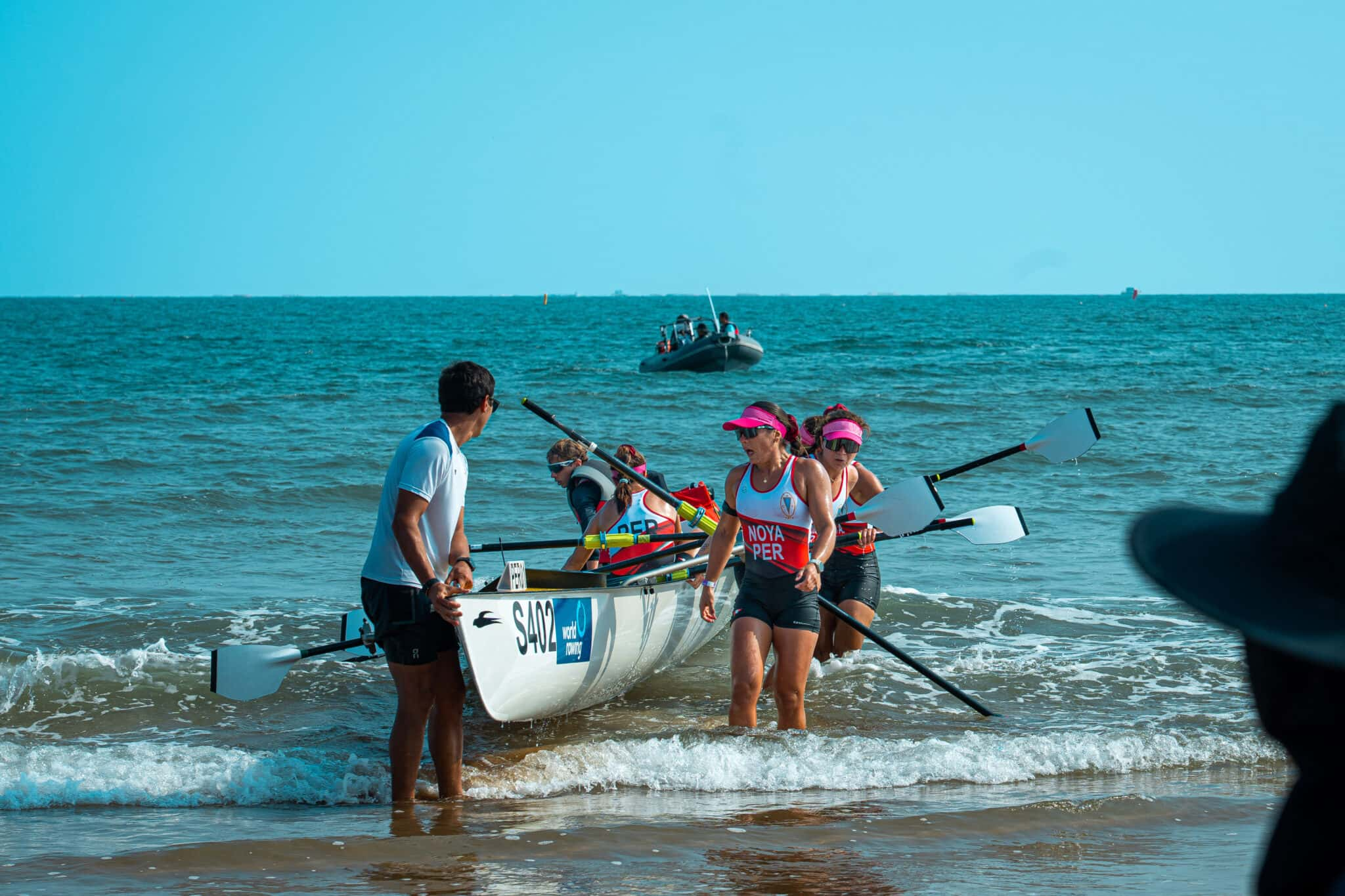
Six boats lined up for the heat of the coastal women’s coxed quadruple sculls. While China were the quickest to get going, it was the Peruvian crew representing Club de Regatas“Lima” who found the fastest boat speed and they had a very slight advantage around the first buoy. With a high rating the Peruvians were able to push off the rest of the field and take the win over China by about 10 seconds. USA02 took third, pushed hard into the finish by Great Britain – three of the British crew doubling up in the women’s solo.
Rogers and Bak out in front in men’s doubles
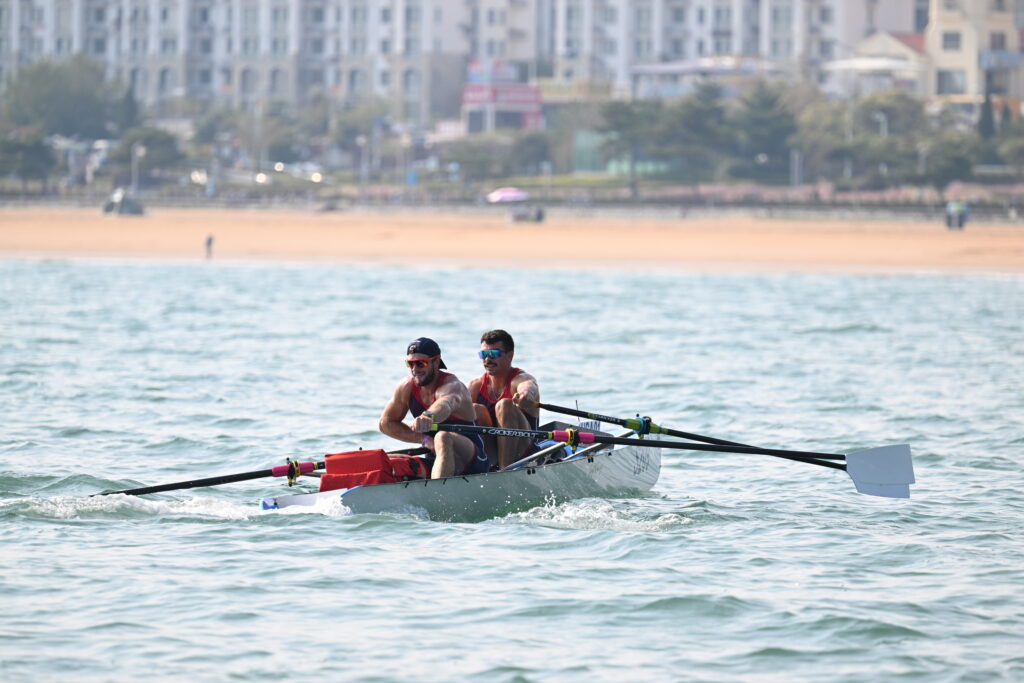
2023 world championsKory RogersandChris Bak(USA01) have had little time in a boat together recently but got off to a good start in the coastal men’s double sculls and were never really troubled. TwinsAlexisandAymeric Fortier(FRA02) rounded the first buoy slightly ahead ofDanieleandGabriele Lonconsole(ITA01), but were able to open up that gap in the second 1000m to claim second behind the USA. The Lonconsoles took third on the finish line, with Kerrian Boulay and Clement Thomas (FRA01) fourth. European champions Kealan Mannix and Ronan Byrne (IRL01) had a good middle 2000m to close up on Boulay and Thomas, but were not able to further narrow the gap in the finishing straight. Team Sichuan, Peiyunxiang Huang and Wang Wenhu (CHN02) were sixth, just behind the Irish.
Heats complete at 2026 World Rowing Championships in Qingdao
Monday brought a busy day of racing in Qingdao, China, as the last of the 4km heats and the B-finals were raced in increasingly challenging conditions. The swell on the water rose as the tide came in, and crews fought for the best position around the various turning buoys.
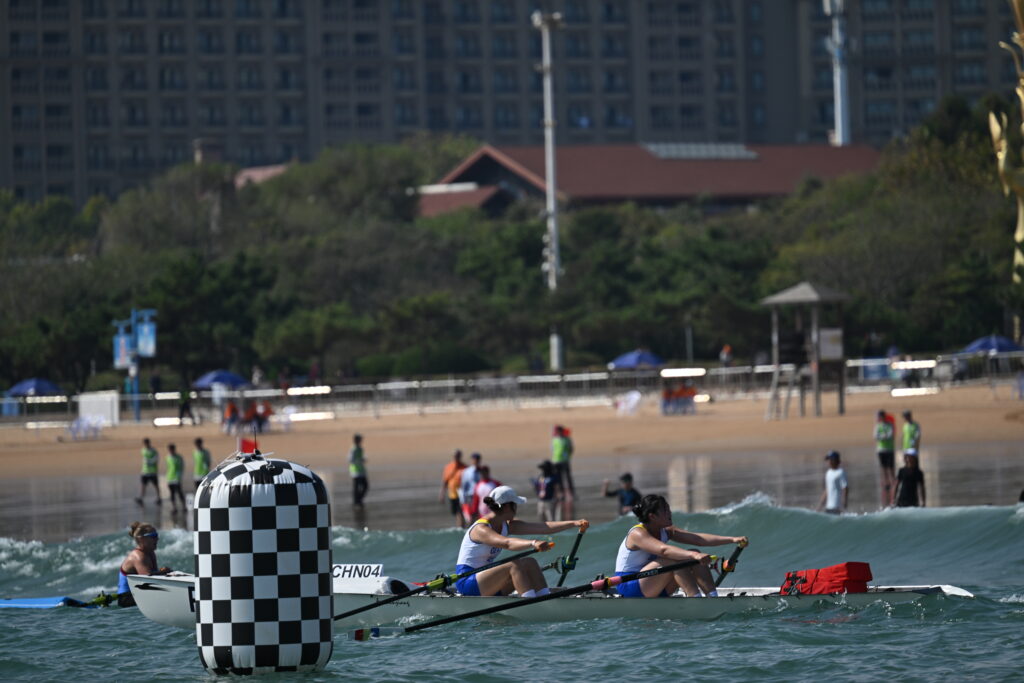
China on top in women’s double sculls
Zhang Yuanyuan and Sun Luping (CHN02) had by far the best start in the heat of the coastal women’s double sculls, giving themselves a slight margin over Alessia and Valeria Palacios (PER01) at the first buoy. The Palacios twins’ experience of rowing together started to pay off on the second leg of the race, and they had closed up to overlap on the Chinese at the second buoy – before missing the turn, having to back down and finding themselves with significant ground to make up. Zhang and Sun were able to scull away to win the heat, with the Peruvians eventually coming in second ahead of Cheng Li and Chen Ke (CHN05) and Solveig Imsdahl and Emma Tierney (USA01).
The German and British boats got themselves entangled on the start; the British crew eventually came through for seventh after losing the best part of 200m initially, and could be a threat come Tuesday’s final.
Diaz and Fortier win solos heats
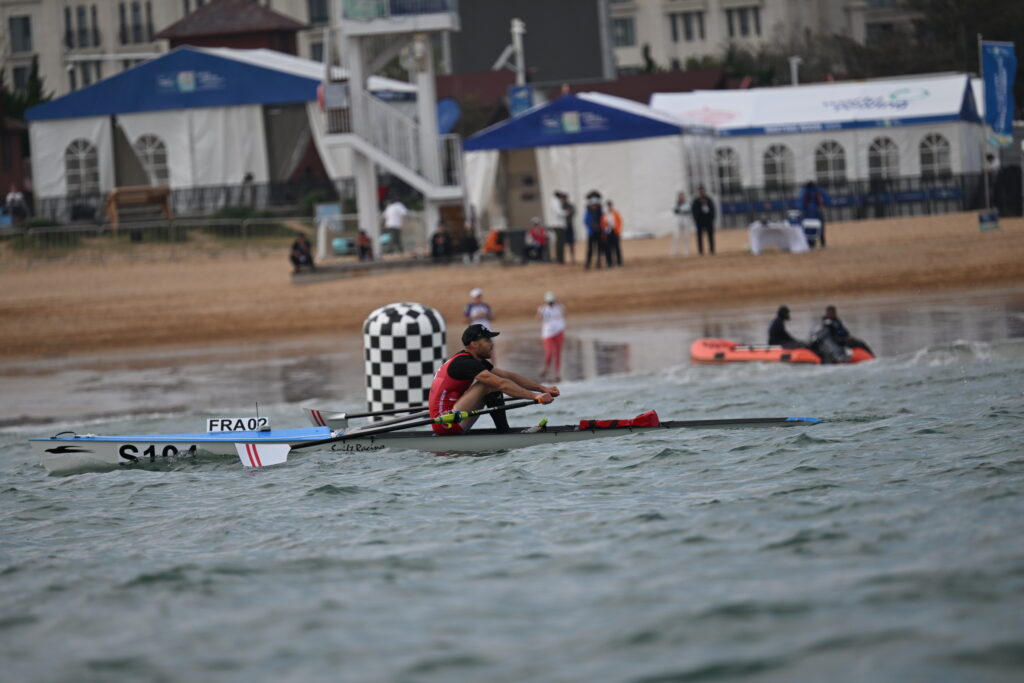
A fascinating contest in the first heat of the coastal men’s solo saw several crews lead at various points in the course, but it was Salvador Diaz (ESP03) who crossed the line in front ahead of Ronan Byrne (IRL03) and Kealan Mannix (IRL01). Erwin Wiltenburg (NED01), who was quickest to 1000m, was fourth. At the back of the pack Michael Hitier (FRA01) and Luca Dell’Elice (ITA04) were in a tight race for the last place in the final, with Hitier eventually taking it.
Heat 2 was led out by Alexis Fortier (FRA02), ahead of Chris Bak (USA01). While the race was tight, Fortier prevailed with a good closing stretch. Behind those two, Joel Naukkarinen (FIN01) was third, despite racing back-to-back in the mixed double sculls and solo.
Mixed doubles set up for cross-continental challenge
The coastal mixed double sculls European champions, Joel Naukkarinen and Eeva Karppinen (FIN01) won heat 1 of the event, after an early close tussle with Kory Rogers and Sera Busse (USA01). They will face off against Long Zhentao and Yang Yujiao (CHN01) in Tuesday’s final, after the Chinese won heat 2. Arthur Sanson and Marine Delanoe (FRA01) were second in heat 2. South America and Africa will also be represented in the final, thanks to solid rows from Peru and South Africa in their heats, as well as crews from Great Britain, Ireland, Spain and Japan.
Italy’s Gavirate emerge in front in race of clashes
The coastal men’s quadruple sculls heat was full of clashes as the big boats sought the best water around the turning buoys. But Italy 04 (ASD Canottieri Gavirate) emerged as the winners, taking an early advantage that kept them clear of the problems behind. They were rowing in memory of a clubmate, Lorenzo Marchetti, who passed away last week. China 02 (Team Liaoning) were second and Monaco 01 third. Team Sichuan (China 03) were excluded at the end of the race.
World Coastal Rowers Gather in Qingdao as Championships Open
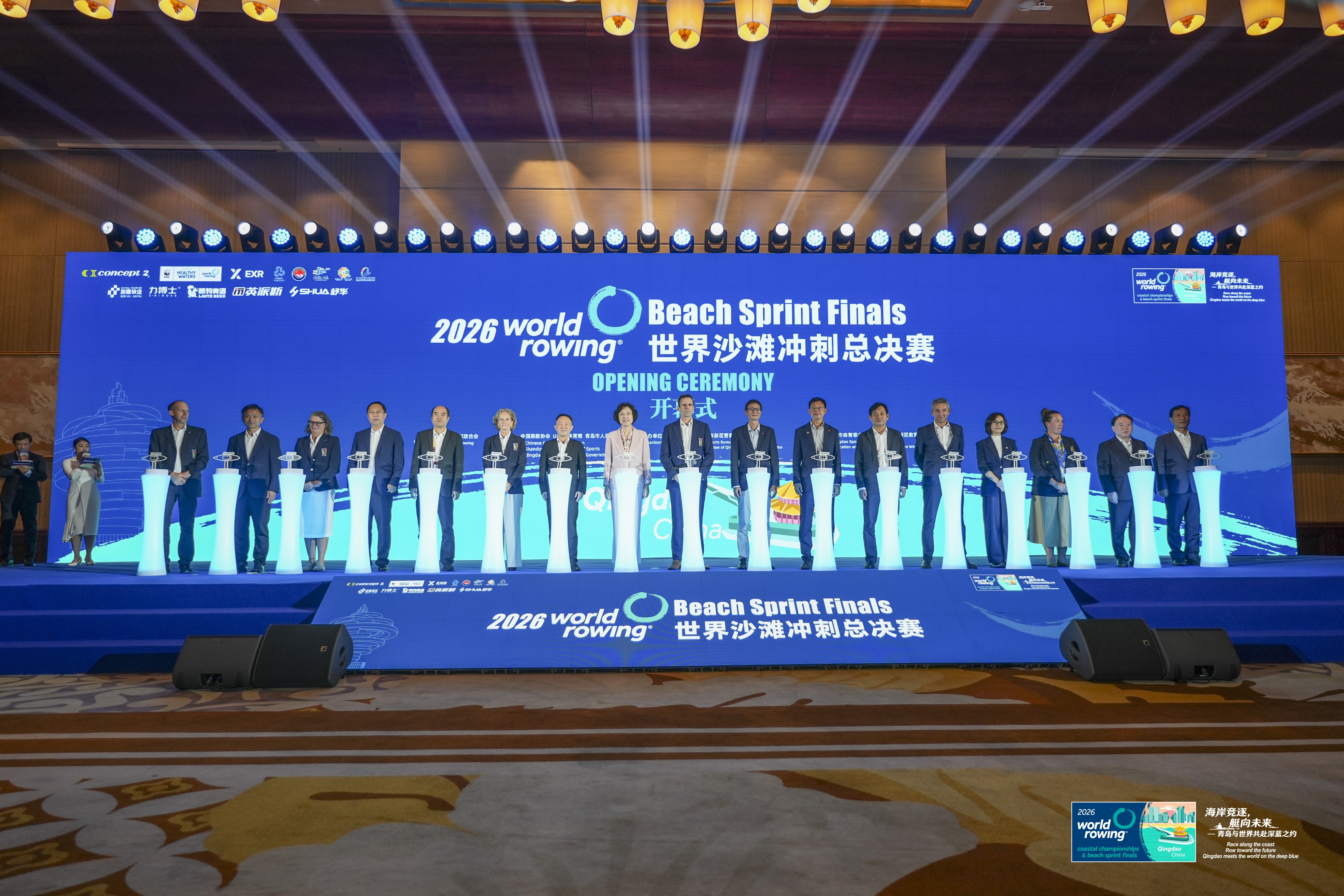
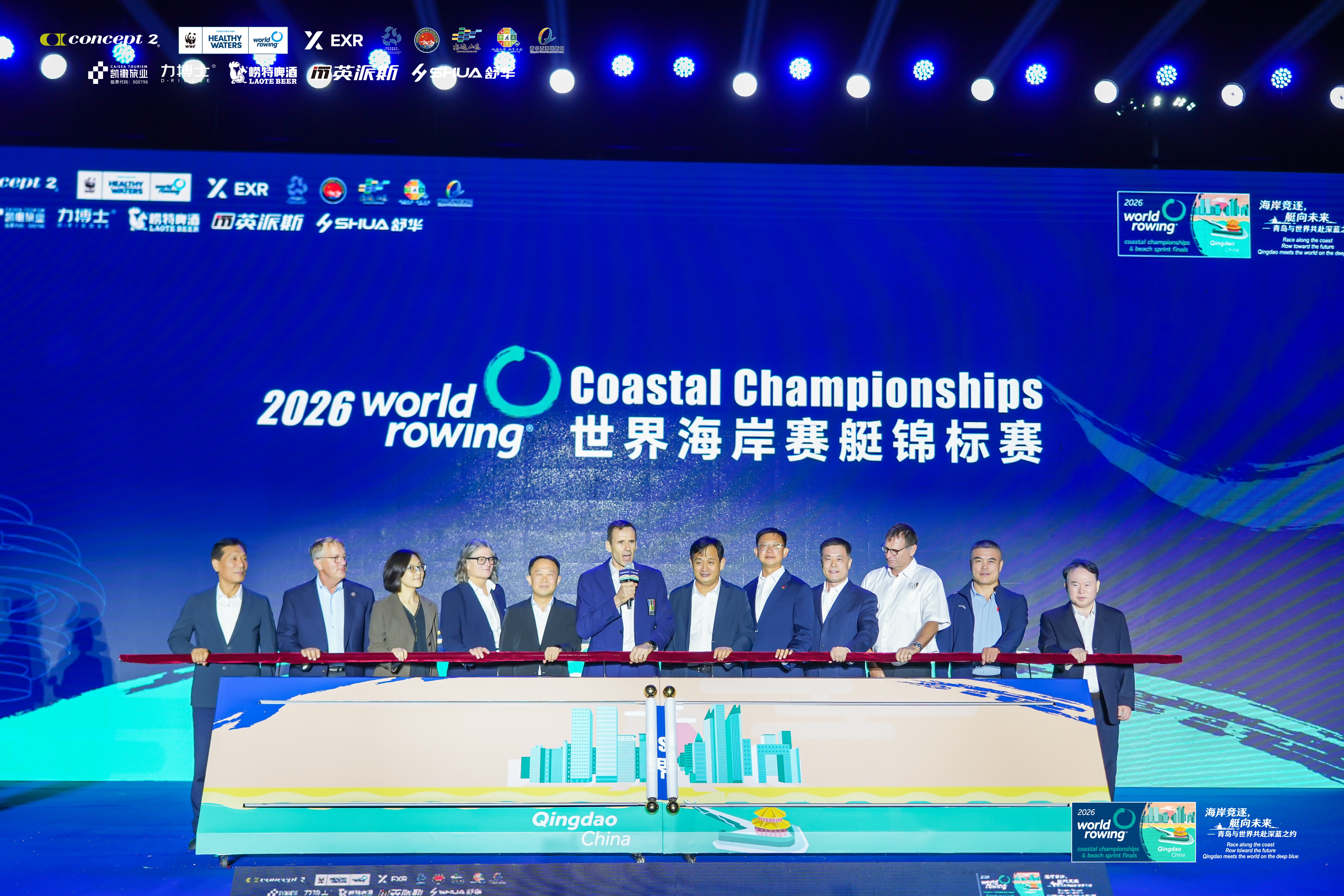
QINGDAO, China — The 2026 World Rowing Coastal Championships opened at Golden Beach in Qingdao’s West Coast New Area, bringing together athletes from 18 countries and regions for competition on the Yellow Sea.
The opening ceremony on October 10 launched an international sporting gathering that also gives visiting athletes a chance to experience Qingdao’s beaches, food and culture.
For Australian rower Sami Blanchard, who represents Commercial Rowing Club, the trip marks both her first visit to China and her first coastal endurance World Championships.
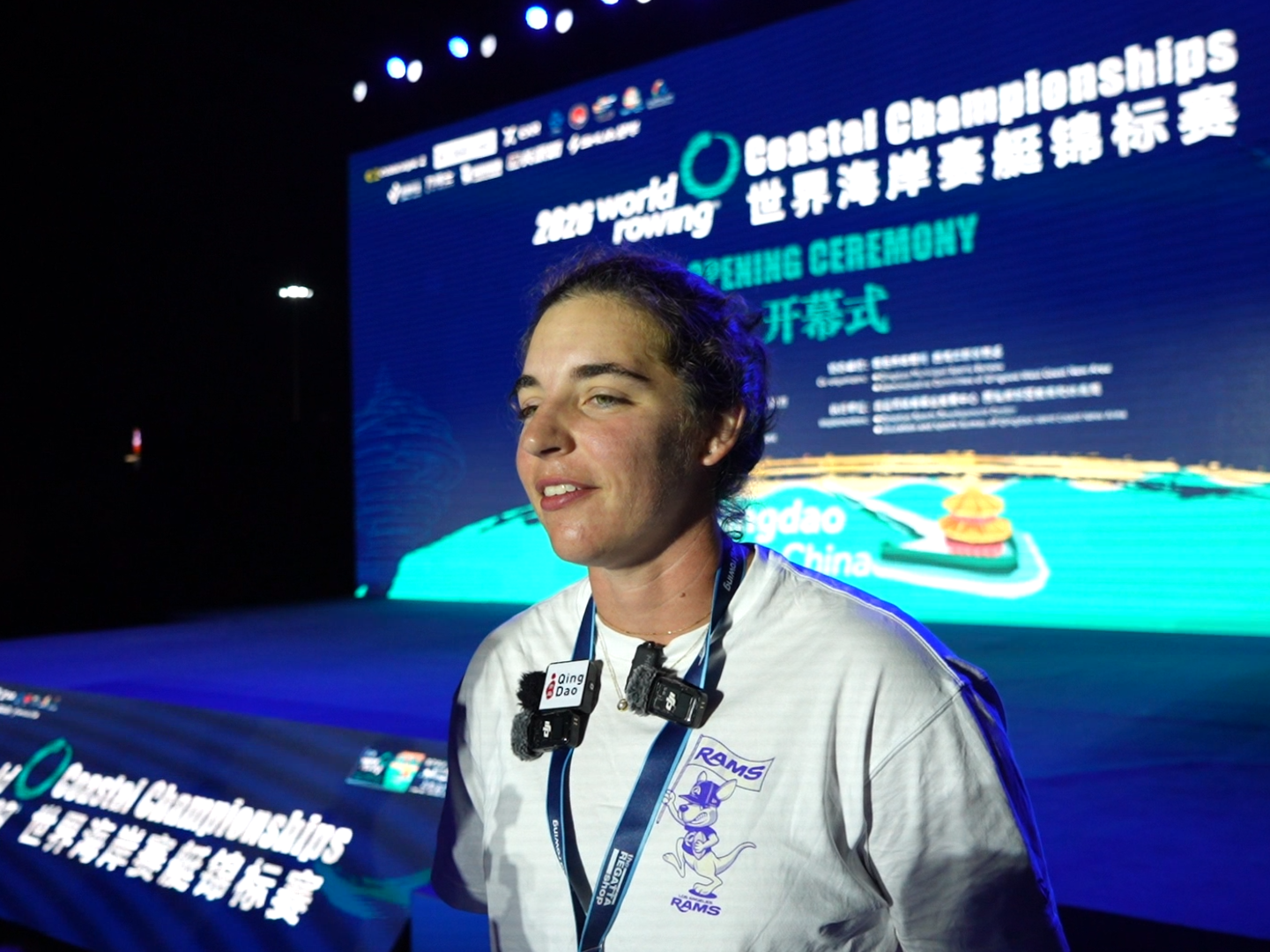
“I’m really excited. I’ve never been to China before, so this is my first time,” she said. “Normally I race beach sprints, but I’m mixing it up this time and racing coastals.”
Blanchard began learning about Qingdao before her arrival. At a Chinese New Year celebration in Australia, she picked up a booklet introducing destinations across China, including Qingdao. She read about the city and searched online to find out more before travelling.
Once she arrived, the city’s welcoming atmosphere and food quickly made an impression.
“Everyone is so friendly. It’s really nice, and the food is great,” she said.
Blanchard began rowing around 2011 and took a break before getting into coastal rowing in 2024. For her first endurance World Championships, she is focused on enjoying the experience rather than setting ambitious expectations.
“I’m really excited just to get out there and race and have a good time,” she said.
She also plans to stay in Qingdao to watch part of the beach sprint events, extending her experience of the city’s coastal sporting scene.
Guin Batten, Chair of the World Rowing Coastal Rowing Commission, highlighted Qingdao’s maritime heritage and its experience hosting sailing events, expressing hope that rowing could build an equally strong presence in the city.
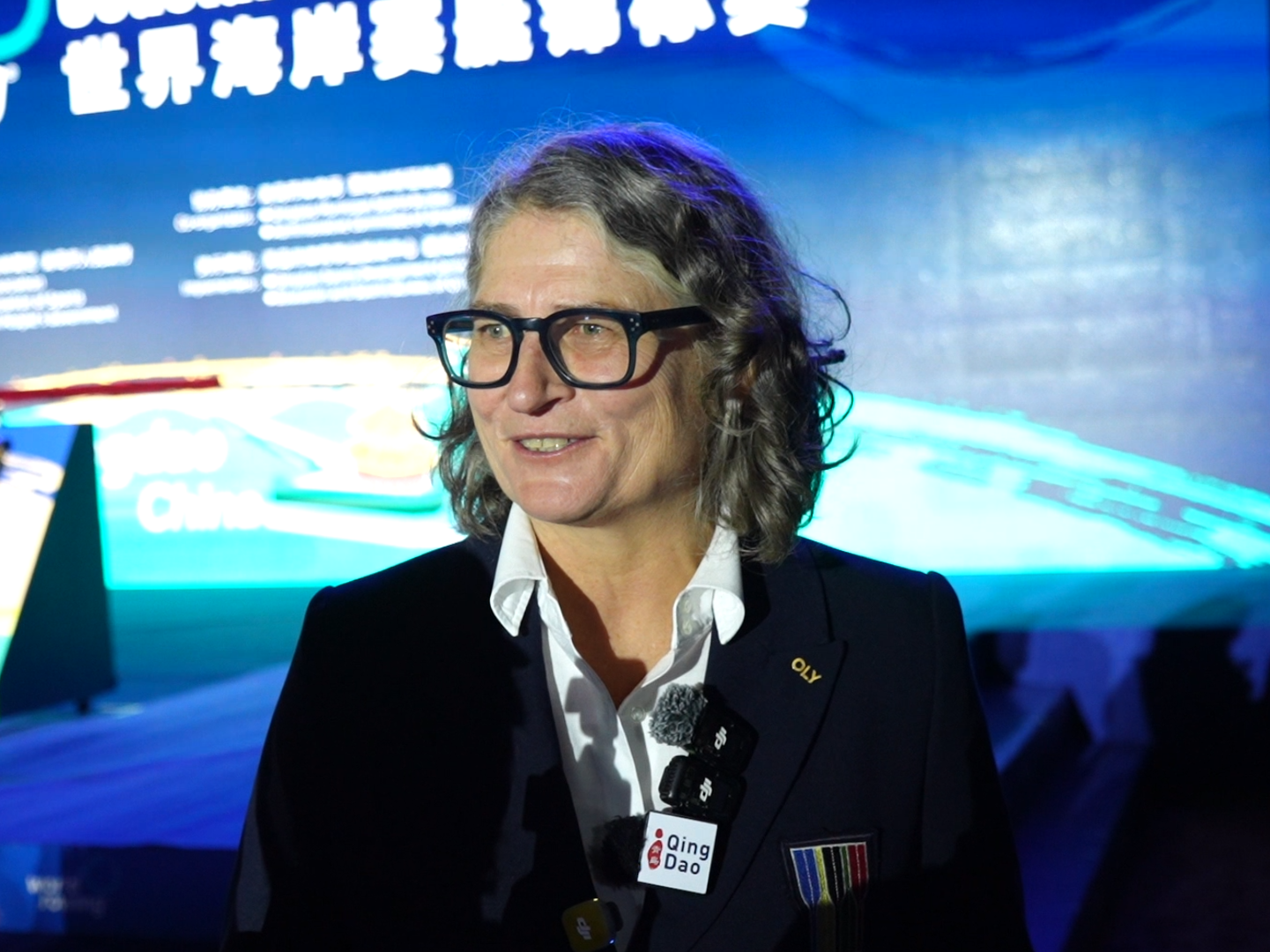
“Maybe it’s time for the rowing events to be as strong in Qingdao as the sailing events,” Batten said.
She also expressed hopes for strong performances by Chinese athletes and encouraged local residents to come to Golden Beach to enjoy the competition.
“The racing will be amazing, the music will be amazing, the atmosphere will be amazing — but only if you come!”

- THE RACE
- SCHEDULE
- ACCOMMODATION
- TRANSPORTATION
- TOURISM
- MEDIA
- VISA